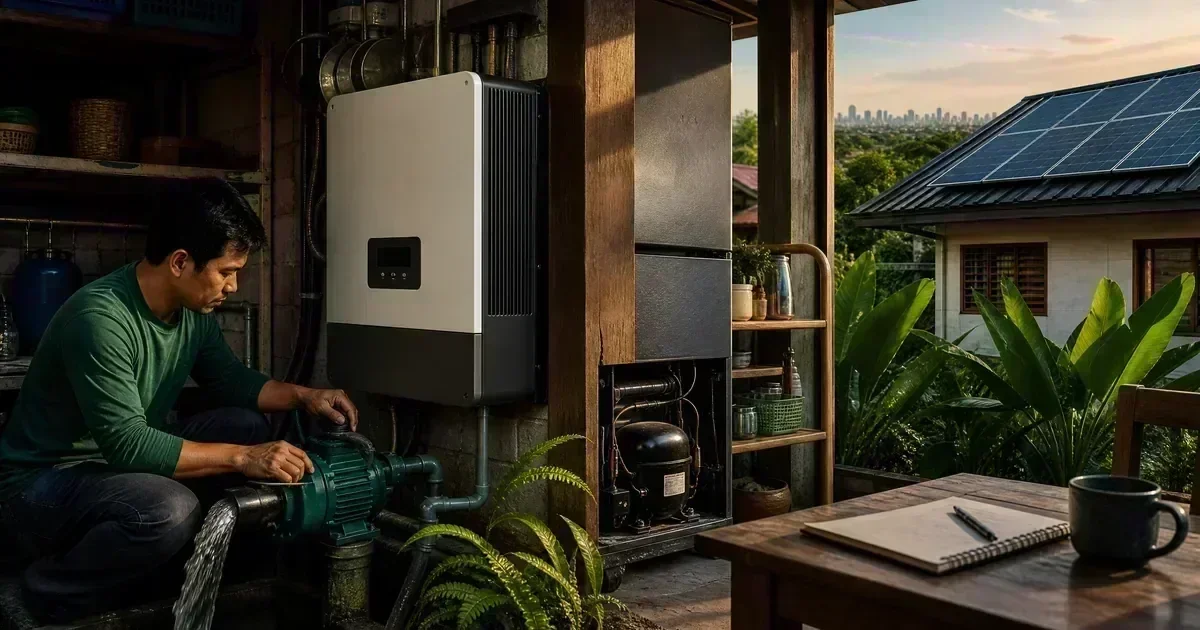
The right inverter depends on the loads, operating mode, battery plan, grid connection, and installation design. Use this guide to compare a listing or quotation without relying only on the headline kilowatt rating. For the next planning step, see solar package quotation guide.
Hybrid Inverter Philippines: 7 Checks Before You Buy
A hybrid inverter in the Philippines should never be selected from kW alone. Confirm continuous AC output, surge capability, battery voltage range, maximum PV voltage/current, MPPT window, backup-output behavior, charging limits and grid interaction.
- Match the inverter to the simultaneous load, not just your biggest appliance.
- Check whether the battery can supply the required current without exceeding its BMS limit.
- Verify every PV string against the inverter's voltage and current limits.
- Identify exactly which circuits stay on during a blackout.
- Confirm the intended grid/export operating mode.
- Check protection, grounding and installation requirements.
- Use the exact model manual, not a marketplace summary, for final compatibility.
A 10kW inverter with an undersized battery or poorly matched PV array is still a poorly designed system.
Decide the operating mode
A grid-tied inverter, hybrid inverter, and off-grid inverter have different purposes and backup behavior. Ask whether the system is intended to export to the grid, provide backup circuits, operate without the grid, or combine these functions. Confirm the transfer and backup limitations in writing. For the next planning step, see 5kW vs 8kW vs 10kW inverter guide. For a personalized system check, use the CalcSolarPH solar calculator.
Compare continuous and surge power
The inverter label is not the whole sizing decision. Compare continuous output, surge capability, motor-starting loads, refrigerator and pump behavior, critical circuits, and the expected load-management plan. A large appliance list may require a different design from a small essential-load backup system.
Check battery compatibility
Confirm battery chemistry, nominal voltage, usable capacity, maximum charge/discharge current, communication protocol, firmware requirements, parallel rules, and protection settings. Never assume that two products are compatible merely because both are described as 48V.
Ask what the quotation includes
Compare monitoring, transfer equipment, breakers, surge protection, cabling, mounting, commissioning, permits, delivery, warranty process, and after-sales support. A low equipment price may exclude the work needed to make the system safe and supportable. For the next planning step, see solar panel buying guide.
Buyer checklist before ordering
- Confirm exact model, datasheet, continuous output, and surge rating.
- List the circuits that require backup and their starting loads.
- Verify battery voltage, BMS communication, charge limits, and usable capacity.
- Ask for single-line diagram, protection schedule, monitoring setup, and commissioning tests.
- Confirm seller, warranty, replacement process, and installation responsibility.
Hybrid, off-grid, and grid-tied: what are you actually buying?
| Inverter type | Best suited to | Important limitation |
|---|---|---|
| Grid-tied | Daytime self-consumption and a properly approved grid connection. | Usually shuts down during an outage unless a compliant backup design is added. |
| Hybrid | Homes that want solar, batteries, and selected backup circuits. | Battery, transfer, protection, and communications must be compatible. |
| Off-grid | Sites with unreliable or unavailable grid service. | Needs enough PV, battery reserve, and generator or load management for cloudy periods. |
The specifications that deserve more attention than the headline kW
Compare continuous output, surge capability, phase configuration, MPPT voltage range, maximum PV input, battery voltage, charge and discharge current, transfer time, protection requirements, monitoring, and communication protocols. The headline kW rating alone does not tell you whether an inverter can start a pump, support an air conditioner, or carry the intended backup panel. For the next planning step, see solar panel brands guide.
For a product-level shortlist, review the 5kW hybrid inverter option, the Deye 8kW hybrid inverter, and the SRNE 10kW hybrid inverter. Confirm the exact model, not only the family name shown in a listing.
Sizing an inverter around real loads in the Philippines
Start with simultaneous running loads, starting loads, operating hours, and the circuits that must remain powered during an outage. Refrigerators, pumps, compressors, air conditioners, welders, and induction appliances can create a different design problem from lights, fans, routers, and televisions. A monthly bill helps estimate energy use, but it does not replace a load schedule or surge assessment.
What a credible installer quotation should include
Ask for the one-line diagram, exact inverter model, PV and battery limits, protection devices, cable sizes, transfer equipment, mounting location, ventilation, grounding or bonding approach, monitoring setup, commissioning tests, warranty responsibilities, and exclusions. If the quotation lists only “5kW inverter” without the model and system scope, it is not yet detailed enough for a confident comparison.
Buyer decision summary
Choose hybrid when backup is important and the site can support a compatible battery and selected-load design. Choose off-grid only when the PV, storage, and load plan can handle cloudy periods without depending on the utility. Treat a larger inverter as a design change, not an automatic upgrade, because it can require different batteries, cabling, protection, and installation work.
The Inverter Spec That Sellers Often Under-Explain
Do not choose an inverter from the headline “5kW” alone. The number normally describes the inverter's continuous AC output, while the PV input, MPPT voltage range, maximum PV current, surge capability, battery voltage and charging limits determine what the complete system can actually do.
| Specification | What you should verify |
|---|---|
| Continuous AC output | Can it support your simultaneous loads without relying on surge power? |
| Surge rating | How long can it sustain the surge, and is it suitable for motors, pumps or compressors? |
| MPPT range | Will the actual panel string voltage stay inside the operating range? |
| Maximum PV current | A high PV wattage number is meaningless if the array current exceeds the input limit. |
| Battery charge/discharge limits | These affect how quickly a battery can charge and how much load it can support. |
If a quote only says “5kW hybrid inverter” and does not identify the exact model and datasheet, treat the quote as incomplete.
Hybrid Does Not Automatically Mean Whole-House Backup
A hybrid inverter can manage solar, battery and grid sources, but that does not mean every appliance can run during a blackout. The battery, inverter output, protected-load wiring and transfer logic still determine what stays on. For a practical design, separate essential loads (refrigerator, router, selected lights, fans and critical outlets) from high-power loads such as kettles, irons, pumps and air-conditioners unless the system is specifically designed for them.
Frequently Asked Questions
Is a bigger inverter always better?
No. A larger unit can increase cost and may still be unsuitable if the battery, wiring, protection, grid connection, or loads are not designed for it. Size the complete system.
Should I choose hybrid or off-grid?
Choose based on grid availability, backup objective, export plans, battery use, and professional design. The correct choice is site- and load-dependent.
Can a hybrid inverter power the whole house during an outage?
Only if the inverter, battery, transfer equipment, protection, and backed-up circuits are designed for the whole-house load. Many installations intentionally use an essential-loads subpanel.
Sources & Further Reading
Use these references to verify technical context. Product specifications, prices, utility requirements, and availability can change, so check the current source and the exact seller listing before making a purchase decision.
- U.S. Department of Energy: Solar Photovoltaic System Design Basics
- U.S. Department of Energy: Energy Storage
- NREL PVWatts: photovoltaic production planning tool
This article is for planning and comparison only. Final electrical design, installation, commissioning, and utility compliance require qualified professional review.