
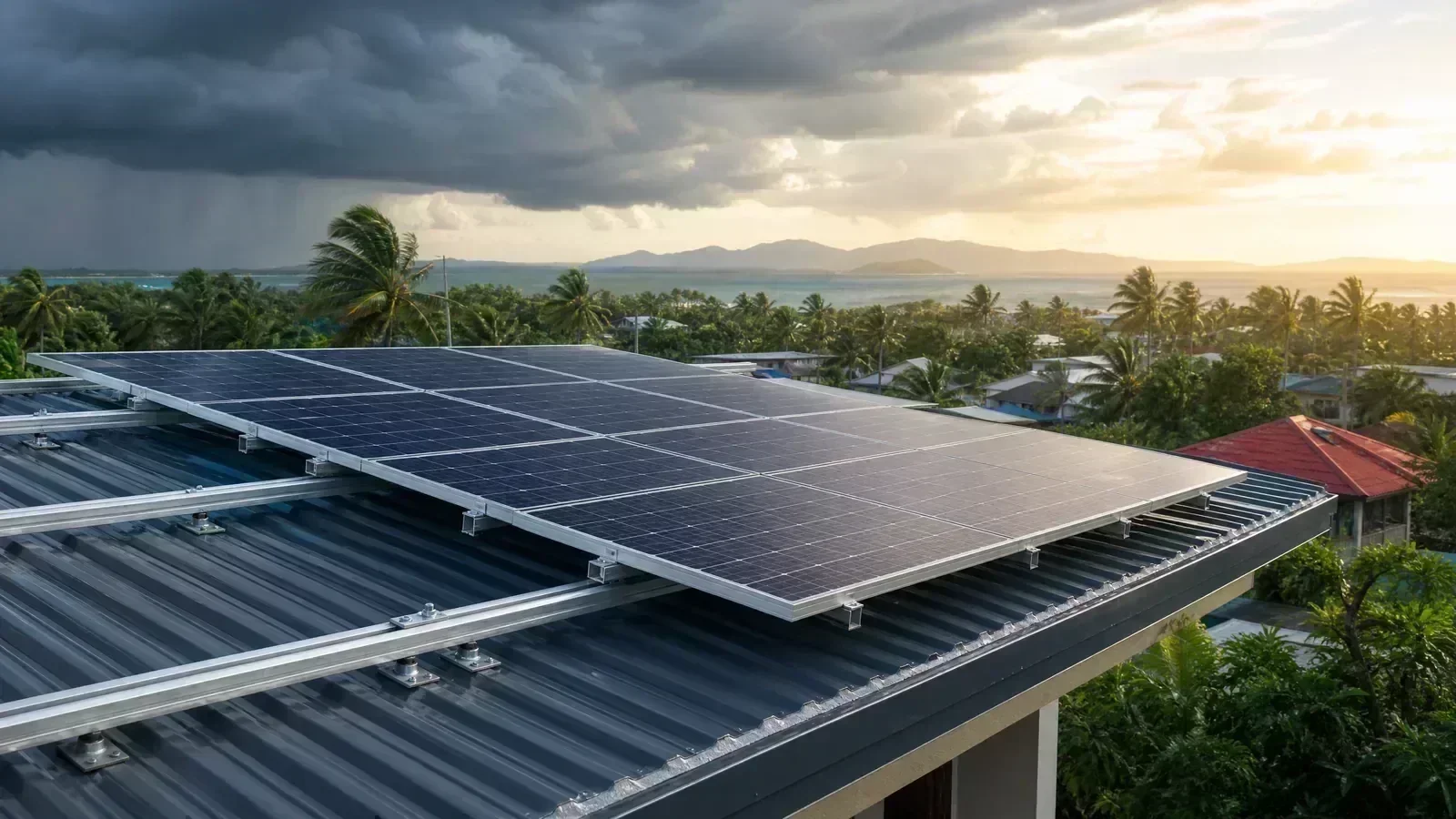
A practical first estimate for Filipino homes: panels, inverter, battery, and the assumptions behind the number.
Formulas, battery assumptions, solar-resource data, cost logic and the limits of the estimate are documented openly.
Philippine dataInspect the regional planning dataset instead of relying on one generic national sun-hours number.
Independent planningUse practical guides on bills, sizing, batteries, regulations, safety and quotations before committing.
Enter your monthly electric bill or kWh usage to get precise panel, inverter, and battery recommendations for your home.
Helps you find the best solar system for your needs.
Your metered monthly kWh (visible on your electric bill). Converted to ₱ using the rate below.
Enter your average monthly bill and rate per kWh to Calculate Setup.
Enter your monthly kWh and rate per kWh to Calculate Setup.
Recomputes using your Monthly Bill & Price per kWh above.
Solar Capacity
0.00 kW
Total DC Array
Inverter Power
0.0 kW
Total AC Output
Battery Storage
0 Ah
12V System
Est. ROI
0y 0m
Payback Time
Planning estimate only: uses about 85% delivered PV performance after normal losses, selected battery usable DoD plus about 90% battery/inverter path efficiency, and an 80% bill-offset assumption for simple payback. Actual results vary with shade, orientation, temperature, usage timing, tariffs, and installer design.
Click "Calculate Setup" to see your load budget, itemized hardware breakdown, and ready-made package recommendations.
Click an appliance to toggle it into or out of your active load calculation.
Total Estimated Investment
₱0.00
Estimated Return on Investment (ROI)
Ready-made packages matched to your computed sizing above, so you can skip the sourcing and go straight to a complete package.
Compare estimated costs, monthly savings, and payback periods for 3kW–10kW residential solar systems in the Philippines at ₱14.70/kWh (Meralco rate class B, residential). Use the calculator above for your specific bill.
| System Size | Panels Needed | Estimated Cost grid-tied, no battery | Monthly Output | Monthly Savings | Payback Period | 25-Year Savings |
|---|---|---|---|---|---|---|
| 3 kW | 6 × 550W | ₱120,000 – ₱150,000 | ~270 kWh | ~₱3,400 | 3.0 – 3.7 yrs | ₱800K+ |
| 5 kW | 9 × 550W | ₱180,000 – ₱230,000 | ~450 kWh | ~₱5,600 | 2.7 – 3.4 yrs | ₱1.3M+ |
| 8 kW | 15 × 550W | ₱280,000 – ₱350,000 | ~720 kWh | ~₱8,900 | 2.6 – 3.3 yrs | ₱2.0M+ |
| 10 kW | 18 × 550W | ₱350,000 – ₱430,000 | ~900 kWh | ~₱11,100 | 2.6 – 3.2 yrs | ₱2.5M+ |
Costs shown are for grid-tied systems (solar panels, grid-tie inverter, mounting, wiring, protection and installation) with no battery. Hybrid systems with a LiFePO4 battery cost more; see the cost FAQ and our packages. Estimates assume ₱14.70/kWh grid rate, 4.5–5 peak sun hours, and net metering. Actual figures vary by roof orientation, shading, and utility rate class. Use the calculator above for a personalized estimate.
Protect your investment year-round: maximize output during rainy season, manage heat in summer, and prepare for typhoons across Luzon, Visayas, and Mindanao.
Maximize output despite clouds
Capture peak sun hours
Protect your investment
Manage heat degradation
Stay updated on solar energy news in the Philippines: ERC policy changes, panel price trends, and net metering developments that affect your solar investment decision.
Aug 21, 2026 • CalcSolarPH Guide
The ERC amended net metering rules in 2026, the cap was raised to 1MW, and the Sariling Kuryente Act mandates 10-day approvals. Learn what changed and how it affects your solar investment.
Read guideAug 20, 2026 • ABS-CBN News
The DOE removed building permits, ERC certificates, and utility pre-approvals for micro-solar systems under the Sariling Kuryente Act, making it easier for Filipino homeowners to go solar.
Read moreAug 19, 2026 • Nikkei Asia
Rising global energy costs are accelerating solar adoption across the Philippines as homeowners seek energy independence.
Read moreAug 18, 2026 • Renewables Now
Major solar-plus-storage partnerships signal growing investor confidence in the Philippine renewable energy market.
Read moreAug 12, 2026 • Bloomberg
Affordable Chinese panels and financing options are making rooftop solar accessible to more Filipino households.
Read moreJul 08, 2026 • SCMP
Structural drivers including rising Electricity rates and falling panel prices make solar a long-term winner for Filipino consumers.
Read moreJun 29, 2026 • OilPrice
The Philippines has overtaken other nations in solar panel imports as demand surges across Luzon, Visayas, and Mindanao.
Read moreJun 28, 2026 • Reuters
Record-high electricity bills are pushing Filipino households toward solar as the fastest-growing clean energy market globally.
Read moreNews links are curated from publicly available sources for informational purposes. Always verify current rates and policies with your utility provider.
Straight answers on sizing a solar system from your Electric bill, costs in pesos, net metering, DIY safety, and battery backup in the Philippines.
Look at the kWh line on your Meralco or local utility bill, not the peso amount. Your monthly consumption in kWh divided by 30 gives your daily usage, which our solar calculator for the Philippines converts into the panel wattage, inverter size, and battery capacity you need, with no site survey required for an initial estimate.
A typical 3kW residential solar setup in the Philippines costs roughly ₱120,000 to ₱150,000 for a grid-tied, net-metering system without a battery (panels, grid-tie inverter, mounting and installation), and roughly ₱160,000 to ₱250,000 for a hybrid system that adds a LiFePO4 battery, depending on panel brand, inverter type and battery capacity. Use the calculator above to estimate cost in pesos based on your own consumption and roof size.
Net metering under the Philippine Renewable Energy Act lets homes with grid-tied solar export excess daytime power to the distribution utility and receive bill credit. Our guides cover the net metering application process, requirements, and how exported kWh affects your monthly bill.
Planning, component selection, cable sizing, and protection design are safe to do yourself with the right guidance. Energized work, roof penetrations in typhoon-prone areas, and utility interconnection should involve a licensed electrician. Our safety-gated decision trees and guides show exactly where the DIY boundary is.
Batteries (LiFePO4 recommended) are optional for grid-tied net metering setups but essential for backup during brownouts and outages common in many provinces. Battery runtime depends on your nighttime loads, and the calculator estimates depth of discharge and backup duration for you.
At typical Philippine rates around ₱14.70 per kWh, a correctly sized system usually pays for itself in about 4 to 7 years, with panels lasting 25 years. Payback depends on your consumption, orientation, and whether you use net metering bill credits.
Yes. Warehouses, factories, and office buildings with large daytime loads are ideal candidates because solar output matches operating hours. Commercial rooftops support bigger arrays, and net metering or net billing arrangements let excess daytime power offset utility charges under Philippine Renewable Energy Act rules.
Net metering lets grid-tied solar systems export excess power to the Meralco grid through a bi-directional meter. Exports are credited against your bill, typically within the month or rolled over. Applications go through Meralco as your distribution utility with a system capacity up to the breaker capacity of your connection, subject to ERC requirements and a certified electrical plan.
Commercial setups often pay back faster than homes, roughly 3 to 6 years, because daytime business loads consume solar output directly at commercial rates that are often above ₱14.70 per kWh. Larger systems also benefit from lower per-watt costs and demand-charge reductions.
Want a personalized answer? Enter your details in the solar calculator above or read our 46 free solar guides.
Calculate how much your utility bill drops when your solar system exports excess power back to the grid, across Meralco, VECO, Davao Light, and Philippine electric cooperatives.
Excess kWh sent to the grid from your solar system
Context only; credits are calculated from measured export kWh and monthly consumption.
Export Rate (per kWh)
₱9.31
Wholesale rate set by ERC for your provider
Monthly Bill Credit
₱2,793
Credits earned from exporting excess solar
Net Monthly Bill After Credits
₱3,307
What you actually pay after solar offsets
Annual Savings from Net Metering
₱33,516
Total yearly benefit from exporting excess power
Export rates are ERC-regulated wholesale rates (approx. 63% of retail). Actual rates vary by provider, rate class, and time of use. Net metering is available under ERC Resolution No. 09 (2013) and updated rules (2023). Check with your provider for current rates.
Curated solar panels, hybrid inverters, and LiFePO4 batteries matched to the calculator output above, built for Philippine weather and budget.
A 550W monocrystalline panel sized for standard residential and small commercial roofs, giving you strong output per panel without needing an oversized array.
A 5kW 24V hybrid inverter that handles a mid-size home's daily loads while charging batteries directly from solar.
Step-by-step guides on sizing, installation planning, net metering, and safety, written for Philippine conditions.
Discover why Lithium Iron Phosphate batteries offer longer lifespans, greater safety, and better long-term savings for Filipino homes.
A step-by-step guide on how to read your electric bill to determine the exact solar system size suited for your appliances.
Discover how rising utility rates impact the payback period of installing rooftop solar power systems.
CalcSolarPH is the Philippines' free solar sizing tool, built to help homeowners and DIY learners plan their solar investment with confidence, avoiding overpriced quotes and undersized systems.
With Meralco rates at ₱14.70/kWh and rising, every peso saved matters. We provide accurate, Philippines-specific guidance on solar panels, inverters, batteries, net metering, and safety, tailored to our tropical climate.
100%
Grid-Optimized Formula
Real-Time
Load & Cost Estimations
To help reduce carbon footprints and monthly utility bills by providing precise calculations for solar panels, inverters, and battery storage systems.
Trusted by Filipino Homeowners
Why Homeowners Choose CalcSolarPH
46
In-depth Philippine solar guides
9
Utility providers covered (Meralco, VECO, MORE & more)
100%
Free tools, no signup required
Mico Reyes
Cavite
"Grabe yung savings ng Meralco bill ko after nag-install ng solar. Yung calculator dito ang nagtulak sa akin na mag-decide talaga."
Janette Villanueva
Davao City
"Bago ko nag-install, nagbasa ako ng guide nila about net metering. Mas malinaw sa akin ngayon kung paano mag-apply sa Davao Light."
Bong Alcaraz
Quezon City
"Yung bill breakdown guide nila ang pinaka-useful sa akin. Real talk, di ako nag-aral ng electrical engineering pero naintindihan ko pa rin."
Rica Mendoza
Laguna
"Ginamit ko yung calculator para i-check kung magkano ang kailangan kong panels para sa 3BR house ko. Tama naman yung estimate!"
Kuya Jun
Batangas
"Matagal akong nag-iinstall ng solar para sa clients ko. Yung safety tips dito ay legit, lalo na yung part about backfeed."
Ate Lorna
Cebu City
"Nag-off-grid kami sa bukid kasi lagi kaming may brownout. Yung guide nila about batteries ang nag-save sa akin from buying wrong specs."
Share Your Solar Experience
Your story helps other Filipino homeowners make smarter solar decisions.