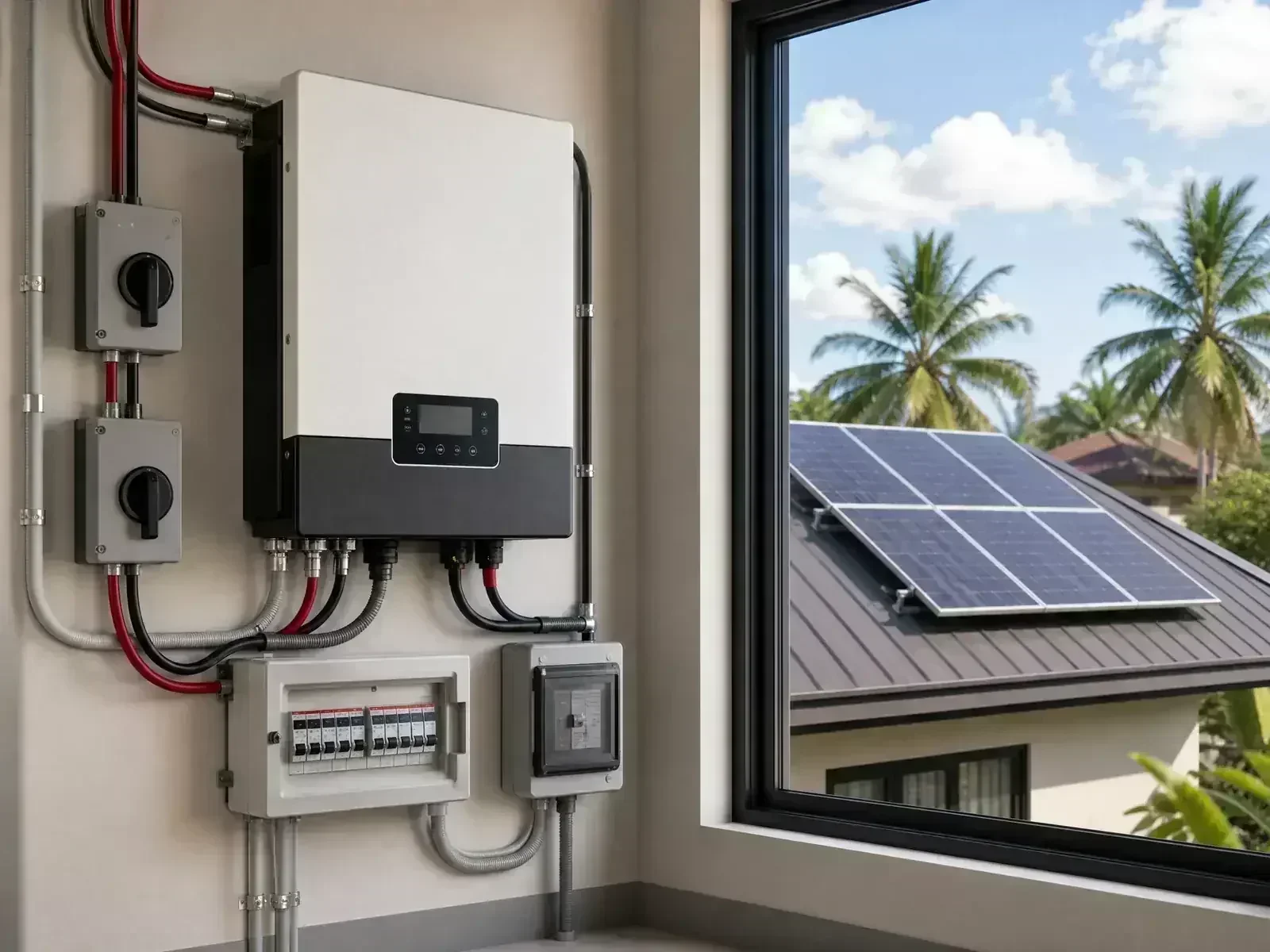
Choosing between a 5kW, 8kW, and 10kW inverter should start with real simultaneous loads and operating goals, not only the highest appliance wattage. A buyer should compare the inverter, battery, PV array, protection, and backup-circuit design as one system. For the next planning step, see solar panel buying guide.
5kW vs 8kW vs 10kW: Which One Should You Buy?
Choose the inverter from your real simultaneous load, surge requirements and system architecture. The goal is not to buy the biggest inverter; it is to avoid both overload and wasted capacity.
| Class | Best starting question |
|---|---|
| 5kW | Can essential loads and selected appliances run together without exceeding continuous/surge limits? |
| 8kW | Do multiple AC units, pumps or kitchen loads create higher simultaneous demand? |
| 10kW | Is the extra output genuinely needed, and can battery, PV, protection and wiring support it? |
Do not pay for inverter capacity that your battery and loads cannot use. Do not force a 5kW unit to carry a load profile it was never designed to handle.
When a 5kW class may fit
A 5kW-class inverter may suit a smaller home or essential-load plan when the simultaneous demand, motor starts, battery current, and backup circuits are within the model limits. Confirm whether large pumps, air conditioners, welders, or other motor loads are excluded or managed. For the next planning step, see solar inverter buying guide. For a personalized system check, use the CalcSolarPH solar calculator.
When an 8kW class may fit
An 8kW-class choice can provide more headroom for a broader backup panel or higher simultaneous demand, but the extra capacity must be supported by battery current, cable sizing, protection, PV input limits, and the intended operating mode. For the next planning step, see solar panel brands guide.
When a 10kW class may fit
A 10kW-class inverter may be relevant to larger residential, farm, or small commercial loads. Ask for a load schedule, starting-current assumptions, phase requirements, grid-interconnection approach, and written exclusions. Do not select it solely because it is the largest unit in a catalog.
Compare the complete quotation
Review continuous and surge output, MPPT range, battery voltage, communication protocol, backup transfer behavior, monitoring, installation, protection, commissioning, warranty, and service. Use the same load assumptions for every quotation.
Buyer checklist before ordering
- Record actual simultaneous and starting loads.
- Confirm single- or three-phase requirements.
- Check PV input limits and battery charge/discharge limits.
- Ask which circuits are backed up and what happens during overload.
- Require a written design, protection schedule, and commissioning handover.
5kW vs 8kW vs 10kW: a practical sizing comparison
| Class | Typical planning use | What must be checked |
|---|---|---|
| 5kW | Smaller homes, essential-load backup, and moderate simultaneous demand. | Motor starts, battery current, backup circuits, and whether large loads are excluded. |
| 8kW | Larger homes or broader backup panels that need more headroom. | Battery bank size, cable and protection rating, PV input, and phase requirements. |
| 10kW | High-demand residential, farm, or small commercial planning cases. | Three-phase requirements, utility coordination, commercial protection, and full load schedule. |
Why inverter size should not be selected from monthly bill alone
Two households can have the same monthly bill but very different peak demand. One may use energy throughout the day, while another may run a pump, air conditioner, refrigerator, and cooking appliance at the same time. The sizing decision should combine energy consumption, simultaneous running watts, starting surge, load priority, backup duration, PV capacity, battery limits, and operating mode.
Compare the 5kW hybrid option, 8kW hybrid option, and 10kW hybrid option at model level. Their usable limits and installation requirements should be checked against the actual design, not inferred from the number in the title. For the next planning step, see solar package quotation guide.
A simple workflow for choosing between 5kW, 8kW, and 10kW
First, separate essential and non-essential circuits. Next, record running and starting demand for pumps, compressors, and air conditioners. Then check the inverter’s continuous and surge ratings, battery charge/discharge current, PV oversizing rules, MPPT window, and transfer behavior. Finally, obtain a quotation that shows which loads are backed up and what happens when the battery reaches its reserve.
When the largest option is still not the correct option
A 10kW inverter can be unsuitable if the battery cannot provide the required current, the PV array is too small, the service entrance is not appropriate, or the site needs a different phase configuration. For systems above 10kW, ask for a commercial-grade design review, protection coordination, structural assessment, and utility or permitting requirements rather than extending a residential rule of thumb.
Buyer decision summary
Use 5kW when the documented simultaneous and starting loads fit a smaller essential-load design. Consider 8kW when the backup panel or demand needs additional headroom and the battery can support it. Consider 10kW only when the load schedule, phase, PV, battery, protection, and site documentation justify the larger system.
5kW vs 8kW vs 10kW: Stop Choosing by Electric Bill Alone
A monthly bill tells you how much energy you bought. It does not tell you the maximum power your appliances demand at the same moment. Two homes with the same monthly bill can require very different inverter sizes.
| Inverter class | Usually makes sense when... | Watch out for |
|---|---|---|
| 5kW | You have moderate simultaneous loads and want a strong residential starting point. | Multiple high-power appliances running together can exceed continuous output. |
| 8kW | The home has larger simultaneous loads or a bigger PV/battery design. | Higher equipment and battery requirements can be wasted if the loads are small. |
| 10kW | You genuinely need high simultaneous output or are designing for a larger home/load profile. | Oversizing raises cost and can leave the system underused. |
Example: a 1,500W kettle + 1,000W iron + 500W rice cooker + 300W miscellaneous load is already about 3.3kW before startup surges. Add a compressor or pump and the instantaneous demand can rise again. That is why appliance schedules and peak-load calculations matter.
The Better Sizing Sequence
Start with daily kWh, then calculate simultaneous peak watts, then account for motor/compressor starting characteristics, then select the inverter, and only after that finalize the PV and battery design. Use the CalcSolarPH calculator to establish the energy requirement before comparing 5kW, 8kW and 10kW equipment.
Frequently Asked Questions
Does 10kW mean the system will always deliver 10kW?
No. Actual output is limited by the inverter, PV array, battery, loads, heat, settings, and grid or backup conditions.
Can I compare inverter size by monthly bill alone?
A monthly bill is a starting point, not a complete sizing input. Load timing, peak demand, appliance starts, roof space, battery objective, and grid behavior also matter.
Is 10kW automatically better than 5kW?
No. It may add cost and require larger batteries, cables, protection, PV input, or a different phase design. Choose the smallest class that safely fits the documented use case.
Sources & Further Reading
Use these references to verify technical context. Product specifications, prices, utility requirements, and availability can change, so check the current source and the exact seller listing before making a purchase decision.
- U.S. Department of Energy: Solar Photovoltaic System Design Basics
- U.S. Department of Energy: Energy Storage
- NREL PVWatts: photovoltaic production planning tool
This article is for planning and comparison only. Final electrical design, installation, commissioning, and utility compliance require qualified professional review.