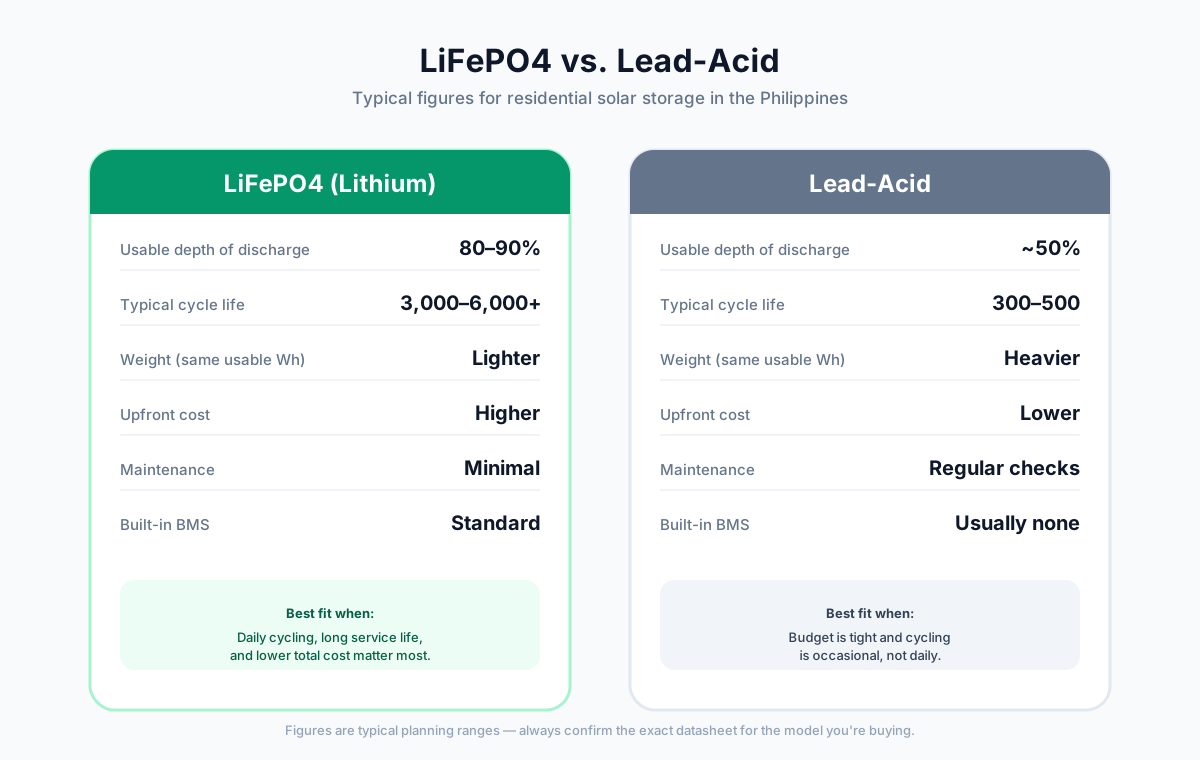
LiFePO4 batteries are often considered for solar backup and storage, but the chemistry name alone does not tell a buyer whether a battery will fit a system. Compare the exact model, usable energy, voltage, BMS limits, communications, warranty, and installation plan. For the next planning step, see solar panel buying guide.
LiFePO4 Battery Philippines: Ah Is Not the Whole Story
When comparing a LiFePO4 battery in the Philippines, calculate nominal energy first: voltage × Ah. A 24V 200Ah battery is about 5.12kWh nominal. The usable AC energy is lower or different depending on the battery's operating window, BMS limits and inverter losses.
- BMS current: determines how much load the battery can safely support.
- Charge current: determines how quickly solar can refill it.
- Communication: CAN/RS485 compatibility may matter for some inverter/battery pairs.
- Temperature and installation: tropical heat and enclosure conditions matter.
- Warranty: check cycle/throughput, temperature and claim conditions.
For backup planning, ask “How many usable kWh do I need?” rather than “How many Ah should I buy?”
Compare usable energy, not only label capacity
Nominal watt-hours or amp-hours are not the same as usable energy. Ask for the recommended depth of discharge, operating reserve, temperature limits, charge/discharge current, and the expected backup load. Use the same assumptions when comparing two quotations. For a personalized system check, use the CalcSolarPH solar calculator.
Check BMS and inverter communication
Confirm the battery management system, protection behavior, CAN or RS485 protocol, supported inverter list, firmware requirements, and parallel-battery rules. A battery can be electrically similar yet still require a different setup or commissioning process. For the next planning step, see solar inverter buying guide.
Review safety and installation
Ask where the battery will be installed, how it will be protected from heat, water, impact, and unauthorized access, and how cables, fuses, breakers, disconnects, and labels will be handled. Do not open, short, puncture, bypass, or continue using a swollen, leaking, overheating, or damaged battery.
Review warranty and support
A buyer should know the warranty period and conditions, who handles a claim, what records are required, how replacement is arranged, and whether the seller provides local technical support. Also ask about shipping restrictions and return handling. For the next planning step, see solar panel brands guide.
Buyer checklist before ordering
- Confirm exact model, voltage, nominal capacity, and usable capacity.
- Verify inverter compatibility and communication protocol.
- Ask for BMS limits, protection behavior, installation requirements, and datasheet.
- Confirm warranty, seller identity, returns, delivery, and service process.
- Require safe commissioning and a written handover.
LiFePO4 battery buying checklist for Philippine solar systems
LiFePO4 is popular for solar storage because buyers often value usable capacity, cycle life, low routine maintenance, and integrated battery-management protection. Those advantages do not remove the need to verify compatibility. The exact battery model, inverter settings, communication protocol, installation environment, warranty process, and charging limits should all be documented. For the next planning step, see 5kW vs 8kW vs 10kW inverter guide.
| Check before buying | What to verify |
|---|---|
| Usable energy | Nominal kWh, recommended depth of discharge, reserve, efficiency, and temperature limits. |
| BMS and communications | CAN or RS485 protocol, supported inverter list, firmware, current limits, and alarm behavior. |
| Parallel expansion | Approved number of batteries, matching rules, busbars, fuses, cable lengths, and commissioning process. |
| Warranty and service | Coverage conditions, required records, claim contact, replacement process, shipping, and local support. |
Usable capacity is more useful than the label
A battery’s nominal capacity is not the same as the energy safely available to the loads. A first-pass estimate can be expressed as usable energy multiplied by inverter efficiency and divided by average load, but the result still needs reserve settings, temperature, battery age, discharge-rate limits, and the actual duty cycle of appliances. Present runtime as a range, not a guarantee.
For product research, compare the Pylontech US3000C, the 51.2V server-rack LiFePO4 battery, and the sealed lead-acid alternative using the same usable-energy and warranty assumptions.
BMS communication and inverter compatibility
A battery may have the correct nominal voltage and still be unsuitable for a particular inverter. Confirm the supported battery list, CAN or RS485 pinout, baud or protocol requirements, firmware, charge-voltage limits, maximum current, low-temperature behavior, and what happens when communication is lost. Do not bypass BMS protection or mix batteries simply because both are described as 48V.
Safety and tropical installation considerations
The installation should protect the battery from direct sun, water, impact, excessive heat, unauthorized access, and poor ventilation. The design should specify disconnects, fuses or breakers, cable sizes, labels, grounding or bonding, and safe service clearance. Stop using a battery that is swollen, leaking, overheating, damaged, or producing an unusual smell, and have it assessed by a qualified professional.
Buyer decision summary
Buy the battery with the clearest usable-capacity data, compatible BMS communication, documented installation requirements, and a practical warranty path. Compare total ownership cost and usable energy rather than choosing solely by nominal kWh or the lowest upfront price.
Battery Capacity Is Not the Same as Usable Energy
A battery advertised as 25.6V 200Ah has a nominal energy of about 5.12kWh (25.6 × 200). That does not mean you should design your loads around 5.12kWh of guaranteed AC energy. Inverter losses, BMS limits, temperature, reserve settings and your chosen depth of discharge reduce what is practically available.
| Specification | Why it matters |
|---|---|
| Nominal voltage × Ah | Gives the battery's nominal stored energy. |
| Recommended charge current | Affects charging time and how gently the battery is treated. |
| Maximum continuous discharge | Determines how much load the battery/BMS can safely support. |
| BMS protections | Look for over/under-voltage, over-current and temperature protection. |
| Warranty terms | Check cycle/throughput conditions, installation requirements and claim process. |
If a seller gives you only “200Ah LiFePO4” without a continuous current rating, recommended charge current and warranty conditions, you still do not have enough information to compare it fairly.
A Simple Runtime Example
A nominal 5.12kWh battery supplying a constant 300W AC load would have a theoretical runtime of about 17 hours before losses and reserve limits. Real runtime will be lower. If the same load rises to 600W, theoretical runtime is roughly 8.5 hours. The lesson is simple: battery size should follow the actual protected load and required backup duration, not a marketing label.
Frequently Asked Questions
Is LiFePO4 automatically the best battery?
Not automatically. The correct choice depends on system compatibility, budget, usable capacity, installation, warranty support, and the buyer’s backup objective.
Can I mix any 48V batteries?
No. Confirm chemistry, model guidance, voltage range, BMS communication, current limits, firmware, parallel rules, and professional commissioning first.
How much LiFePO4 battery capacity do I need?
Start with essential load watt-hours and target runtime, then apply usable-depth, inverter-efficiency, reserve, temperature, aging, and manufacturer limits. Have the final design checked before purchase.
Sources & Further Reading
Use these references to verify technical context. Product specifications, prices, utility requirements, and availability can change, so check the current source and the exact seller listing before making a purchase decision.
- U.S. Department of Energy: Solar Photovoltaic System Design Basics
- U.S. Department of Energy: Energy Storage
- NREL PVWatts: photovoltaic production planning tool
This article is for planning and comparison only. Final electrical design, installation, commissioning, and utility compliance require qualified professional review.