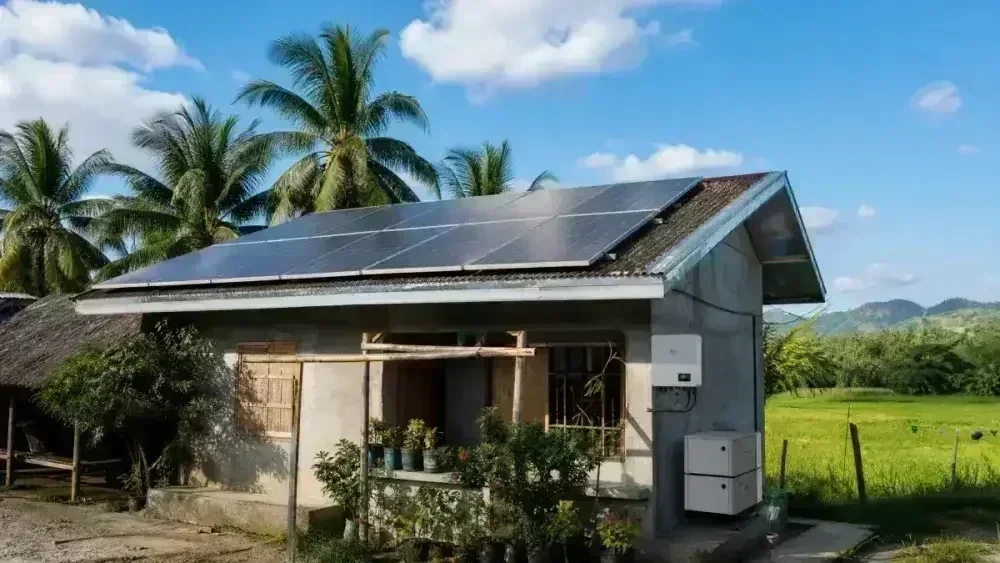
For thousands of Filipino families in rural barangays, island communities, and far-flung agricultural areas, reliable electricity remains out of reach. The national grid has not yet reached many parts of Mindanao, the Visayas, and remote Luzon provinces, and those connected to electric cooperatives often face 6–10 hour daily brownouts. Off-grid solar power is the most practical, affordable, and increasingly popular solution for energy independence in these areas.
Here is the practical version of setting up an off-grid solar system for a provincial home in 2026: what components you need, how much it costs, which battery type is best, and real project data from actual installations across the Philippines.
How an Off-Grid Solar System Works
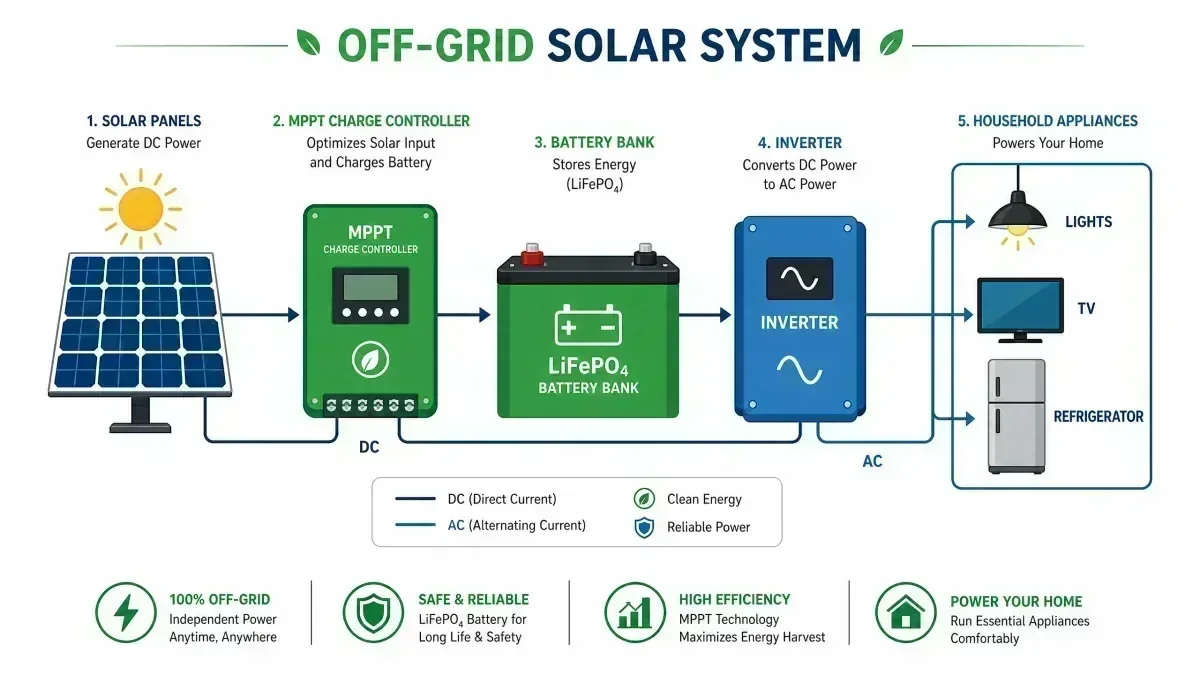
Unlike grid-tied systems that depend on Meralco or your local electric cooperative, an off-grid solar system operates completely independently. The system has four main components working together: solar panels generate DC electricity from sunlight, a MPPT charge controller regulates the power flow and maximizes energy harvest, a battery bank stores excess energy for nighttime use, and an inverter converts stored DC power to AC electricity that runs your household appliances. For the next planning step, see how much solar power your home actually needs.
During daylight hours, your solar panels generate power that charges the batteries and simultaneously runs your loads. When the sun goes down, the battery bank takes over completely. No grid connection is needed. This makes off-grid solar the only true solution for areas without any utility infrastructure.
Off-Grid System Sizing for Philippine Homes
Sizing your off-grid system correctly is critical. Undersize it and you'll run out of power at night; oversize it and you waste money on unused capacity. The key metric is your daily energy consumption in kilowatt-hours (kWh). Here's a typical breakdown for a provincial Filipino household:
| Appliance | Wattage | Hours/Day | Daily kWh |
|---|---|---|---|
| LED Lights (3× 9W) | 27W | 6 hrs | 0.16 kWh |
| Electric Fan | 50W | 8 hrs | 0.40 kWh |
| Television (32") | 50W | 4 hrs | 0.20 kWh |
| Phone/Tablet Charging | 20W | 3 hrs | 0.06 kWh |
| Refrigerator (10 cu ft) | 80W (avg) | 8 hrs (cycles) | 0.64 kWh |
| Rice Cooker | 400W | 1 hr | 0.40 kWh |
| Water Pump (optional) | 370W | 2 hrs | 0.74 kWh |
| Total Daily Load | ~2.6 kWh |
For a household consuming around 2.5–3 kWh per day, a 3 kW off-grid system is the recommended starting point. Larger households with air-conditioning or electric water heaters should consider a 5 kW system.
Component Costs: 3kW Off-Grid System (2026 Prices)
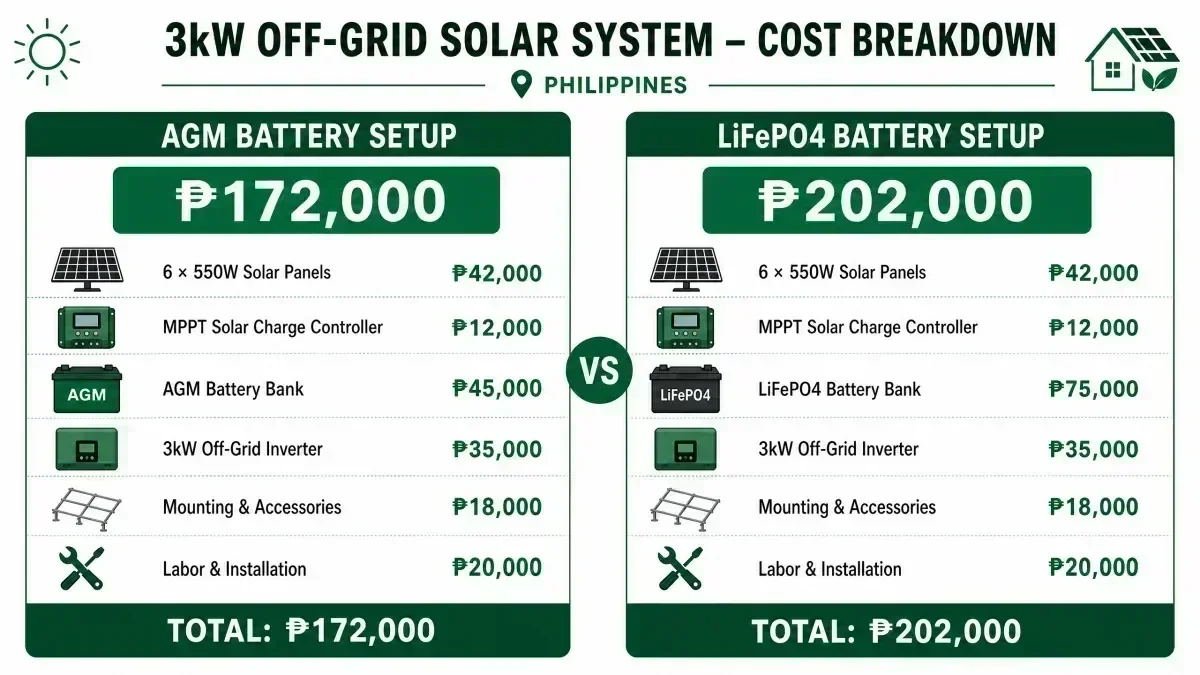
| Component | AGM Setup | LiFePO4 Setup |
|---|---|---|
| 6× 550W Solar Panels | ₱42,000 | ₱42,000 |
| MPPT Charge Controller (60A) | ₱12,000 | ₱12,000 |
| Battery Bank (10kWh) | ₱45,000 | ₱75,000 |
| 3kW Off-Grid Inverter | ₱35,000 | ₱35,000 |
| Mounting & Wiring | ₱18,000 | ₱18,000 |
| Installation Labor | ₱20,000 | ₱20,000 |
| Total (Remote area +₱15K transport) | ₱187,000 | ₱217,000 |
Note that remote provincial areas may add ₱15,000–₱30,000 for transport and extended labor. The LiFePO4 option costs ₱30,000 more upfront but lasts 3–4× longer than AGM batteries, making it the better long-term investment. For current prices on complete off-grid kits and individual components, browse our solar product catalog with Philippine listings.
AGM vs LiFePO4: Which Battery for Provincial Use?
In tropical Philippine conditions, battery choice is one of the most consequential decisions in your off-grid build. Here's the honest comparison:
| Factor | AGM (Sealed Lead-Acid) | LiFePO4 (Lithium) |
|---|---|---|
| Lifespan | 3–5 years | 10–15 years |
| Charge Cycles | 500–800 | 3,000–6,000 |
| Depth of Discharge | 50% max | 80–90% recommended |
| Heat Tolerance | Poor (degrades fast above 35°C) | Good (handles PH heat) |
| Maintenance | Low but degrades silently | Zero (BMS managed) |
| Weight | Heavy (120+ kg for 10kWh) | Light (40–50 kg for 10kWh) |
| Best For | Tight budget, occasional use | Daily use, long-term |
For a home that depends on solar every single day, which is the reality for most provincial off-grid setups,, LiFePO4 is the clear winner. The extra ₱30,000 upfront pays for itself within 4–5 years when you factor in AGM replacement costs. Our LiFePO4 vs Lead-Acid comparison guide goes deeper into this decision.
Real Project: 5kW Off-Grid Setup in Cebu Province
Here's an actual off-grid installation completed in a rural Cebu barangay, serving as a realistic reference for what a complete provincial setup looks like:
| Component | Specification |
|---|---|
| Solar Array | 10× 550W panels (5.5kW total) |
| Inverter | Deye 5kW (off-grid configuration) |
| Battery Bank | 4× 100Ah LiFePO4 (~16kWh usable) |
| Charge Controller | 60A MPPT (integrated in Deye inverter) |
| Daily Loads | Rice cooker, fridge, 3 LED lights, phone charging, small TV (~6–7 kWh/day) |
| Battery Autonomy | 2.5 days without sun |
| Total Cost | ₱320,000 (including transport to island) |
| ROI vs Generator | 7–8 years (at ₱4,000/month fuel savings) |
The homeowner previously spent ₱4,000–₱5,000 monthly on gasoline for a 3kW generator. With the solar system, that recurring cost dropped to zero. The system has been running reliably for over 18 months with no issues.
Permits and Legal Requirements
The good news: off-grid solar systems do not require net metering approval because they have no grid connection. There's no ERC or utility paperwork for the solar installation itself. However, you may still need:
- Electrical permit from your local LGU (municipal engineering office), required for any permanent electrical installation
- Building permit if mounting panels on a new structure or significantly modifying your roof
- Barangay clearance: some LGUs require this for electrical work
These permits are typically inexpensive (₱500–₱2,000) and straightforward to obtain. Unlike grid-tied systems, there's no interconnection agreement, no utility inspection, and no waiting period.
Choosing the Right Inverter for Off-Grid
The inverter is the heart of your off-grid system. In the Philippine market, these brands have proven reliable for off-grid use:
- Deye: Best overall. Hybrid-capable (can add grid connection later), integrated MPPT, WiFi monitoring, ₱35,000–₱55,000 for 3–5kW models
- Growatt: Budget-friendly off-grid inverter, good for simple setups, ₱25,000–₱40,000
- Victron: Premium quality, modular design, excellent for larger systems, ₱60,000+ for 3kW+
- Must: Entry-level option for basic lighting and phone charging setups, ₱8,000–₱15,000
For most provincial homes, a Deye hybrid inverter is the smartest choice. It works in off-grid mode now, but can accept a grid connection later if your area gets electrified, without replacing the inverter. Browse recommended inverters in our hardware catalog. For the next planning step, see off-grid vs hybrid vs grid-tied guide.
Maintenance Tips for Rural Conditions
Provincial solar systems face unique challenges: dust, humidity, salt air (coastal areas), and limited access to technical support. Here's how to keep your system running:
- Clean panels every 2 weeks during dry season; dust reduces output by 10-15%
- Check battery terminals monthly: corrosion from humidity is the #1 cause of failures
- Keep batteries shaded and ventilated: direct sun degrades LiFePO4 cells faster
- Test your system during rainy season: if autonomy drops below 1 day, add more battery capacity
- Have a backup plan: a small gasoline generator (1kW) for extended rainy periods is a smart redundancy
Our solar panel maintenance guide covers cleaning techniques and seasonal adjustments in more detail.
Common Mistakes to Avoid
After reviewing dozens of off-grid installations across the Philippines, these are the most common mistakes that lead to system failures:
- Undersizing the battery bank: People buy enough panels but skimp on batteries, then wonder why power runs out at 9 PM
- Using PWM instead of MPPT: PWM controllers waste 20–30% of your panel output; MPPT is worth the extra ₱5,000
- Wrong wire gauge: Long cable runs in rural setups need thicker wires to prevent voltage drop
- No surge protection: Lightning strikes during typhoon season can fry your inverter without proper protection
- Buying cheap no-brand panels: Stick with Jinko, Trina, Longi, or JA Solar for reliability
Off-Grid vs Generator: The Real Cost Comparison
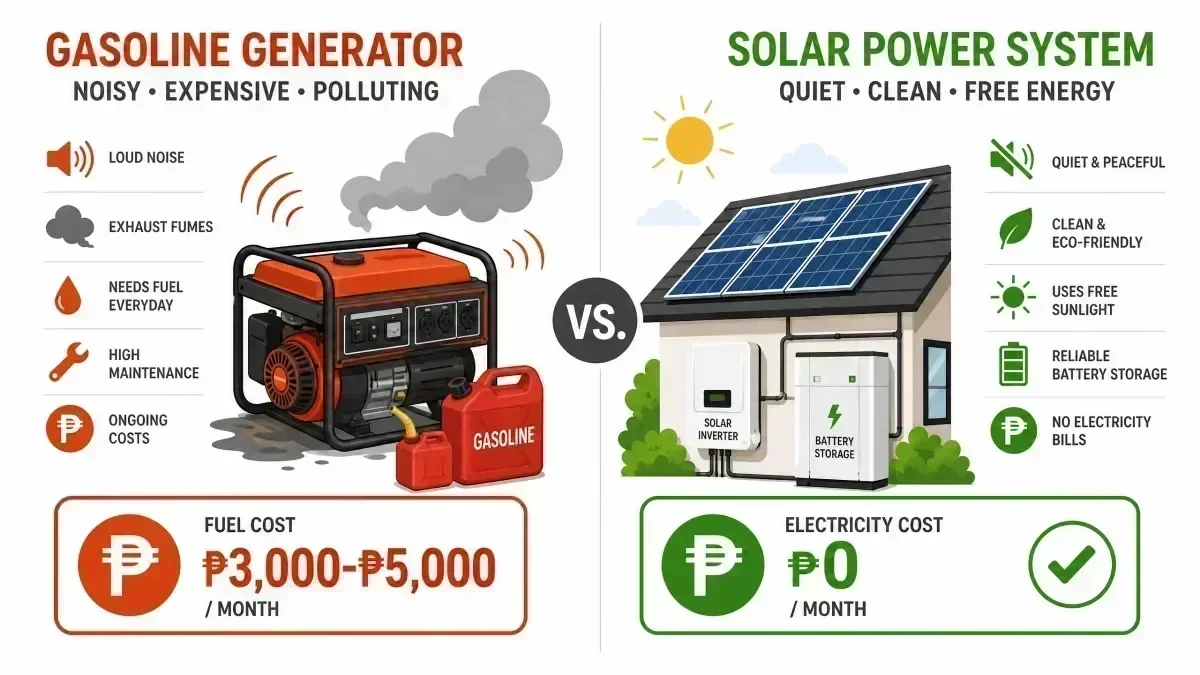
Many provincial households currently rely on gasoline generators for electricity. Here's why switching to solar makes financial sense:
| Factor | Gasoline Generator (3kW) | Off-Grid Solar (3kW) |
|---|---|---|
| Initial Cost | ₱15,000–₱25,000 | ₱180,000–₱220,000 |
| Monthly Fuel Cost | ₱3,000–₱5,000 | ₱0 |
| Annual Operating Cost | ₱36,000–₱60,000 | ₱0–₱3,000 (maintenance) |
| Lifespan | 5–8 years | 20–25 years (panels) |
| Noise | 70–80 dB (very loud) | Silent |
| 5-Year Total Cost | ₱195,000–₱325,000 | ₱190,000–₱230,000 |
| 10-Year Total Cost | ₱375,000–₱625,000 | ₱210,000–₱260,000 |
By year 5, solar has already matched or beaten the generator's total cost. By year 10, solar saves you ₱200,000–₱360,000, and the panels keep producing for another 15+ years. For the next planning step, see solar-ready home planning guide.
Where to Buy Off-Grid Solar Equipment in the Philippines
For provincial buyers, online marketplaces offer the best selection and often competitive pricing. Here's what to look for:
- Solar panels: Look for Jinko, Trina, or Longi 550W mono panels. Verify the seller is an authorized distributor. Check our brand comparison guide before buying.
- Inverters: Deye and Growatt are widely available on Shopee and Lazada. Buy from official stores or authorized resellers only.
- Batteries: LiFePO4 48V 100Ah units are the standard. Pylontech US3000C is a reliable choice if available.
- Charge controllers: EPEver, Victron, or the MPPT built into your hybrid inverter.
Browse our curated recommended hardware catalog for vetted products with current Philippine prices and verified seller links.
Step-by-Step: Planning Your Off-Grid Setup
Here's the recommended planning sequence for a provincial off-grid installation:
- Calculate your daily load: List every appliance, its wattage, and hours of use. Total should be your daily kWh target.
- Choose system size: 3kW for basic needs (~2.5 kWh/day), 5kW for full household (~6–8 kWh/day).
- Select battery type: LiFePO4 for daily use, AGM only for occasional/emergency backup.
- Pick your inverter: Deye hybrid for flexibility, Growatt for budget.
- Get permits: Electrical permit from LGU (₱500–₱2,000).
- Order components: Use our product catalog for vetted options.
- Hire or DIY install: Professional installation recommended for systems 3kW+.
- Commission and test: Verify battery autonomy during a cloudy day before relying on it.
Use our free solar calculator to estimate your exact panel, battery, and inverter requirements based on your specific load profile.
Frequently Asked Questions
Can I start with a small off-grid system and expand later?
Yes. Start with a 1kW system for basic lighting and phone charging (₱50,000–₱80,000), then add panels and batteries as your budget allows. A Deye hybrid inverter makes expansion easy since it accepts additional MPPT inputs.
What happens during typhoon season with no sun for days?
A properly sized LiFePO4 battery bank provides 2–3 days of autonomy. For extended cloudy periods, keep a small generator as backup, or reduce loads to essentials only (lights and phone charging). For the next planning step, see essential-loads backup guide.
Is off-grid solar safe for children in the household?
Yes, when properly installed. All wiring should be in conduit, the battery bank should be in a ventilated enclosure, and the inverter should be wall-mounted out of reach. LiFePO4 batteries have built-in BMS protection against overcharge and short circuits.
How long does installation take in remote areas?
Typically 2–3 days for a 3kW system, 4–5 days for 5kW. Transport logistics may add 1–2 days in island or mountainous areas.
Can I run a refrigerator on off-grid solar?
Yes. A standard 10 cu ft refrigerator draws about 80W average and consumes roughly 0.6–0.8 kWh per day. A 3kW system with 10kWh battery handles this easily, even with other appliances running.
Want to size your own system? Use the free solar calculator to estimate your panel, inverter, and battery needs from your monthly bill.
Sources & Further Reading
Use these references to verify technical context, current utility procedures, and safety or planning information. Rules, tariffs, product specifications, and availability can change, so check the source’s current publication date before making a purchase or installation decision.