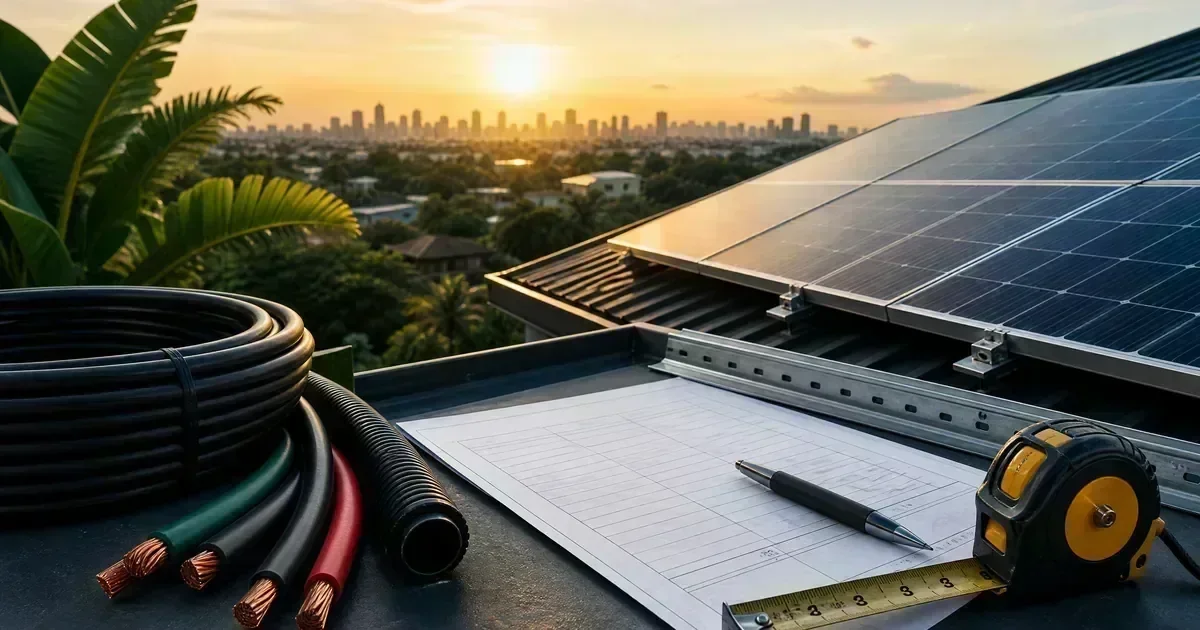
Understand PV and battery cable sizing, voltage drop, temperature, routing, and protection questions before asking an installer to verify the final design. For the next planning step, see typhoon-proof solar installation guide.
Why cable size is a system decision
Cable selection affects heating, voltage drop, fault protection, efficiency, mechanical reliability, and warranty compliance. The same wire gauge may behave differently depending on conductor material, insulation rating, bundling, ambient temperature, conduit, roof exposure, and route length. Never choose a cable solely because an online photo shows it being used in a similar system. For the next planning step, see solar wiring architecture guide. For a personalized system check, use the CalcSolarPH solar calculator.
Separate the design inputs
Record circuit voltage, expected continuous current, maximum or short-circuit current where relevant, one-way route length, conductor material, insulation rating, installation method, ambient temperature, and whether positive and negative conductors share a route. Battery circuits can carry very high current at comparatively low voltage, so their cable and protection decisions deserve particular attention. For the next planning step, see solar backfeed and transfer-switch safety guide.
Understand voltage drop
Voltage drop is the loss created by resistance along the circuit. It matters more on long runs and low-voltage battery systems. A planning worksheet should show the assumed current, total conductor path, resistance basis, and the allowable drop used by the designer. If a result appears unusually small, check whether the calculation used one-way length instead of the complete circuit path.
Match protection to the conductor
A fuse or breaker protects a conductor and equipment from excessive current; it is not a substitute for correct cable sizing. The device must be suitable for the circuit type, interrupt fault current, voltage, polarity, and manufacturer requirements. DC protection must be specifically rated for the relevant DC voltage and current. Do not replace a nuisance trip with a larger device without finding the cause.
Account for heat, sunlight, and movement
Roof runs experience heat, UV, wind movement, water, and abrasion. Battery cables experience bending, vibration, and high current. Use correctly rated PV cable, glands, lugs, strain relief, and support. Keep cables away from sharp metal edges and avoid loose loops that can rub against mounting hardware.
Use a review worksheet
Before installation, ask the designer to show the current basis, route length, voltage-drop result, ampacity adjustment, protection rating, lug compatibility, and termination torque requirements. The homeowner does not need to guess the final size; the valuable DIY work is making the assumptions visible and checking that the parts list is consistent.
A practical DIY evidence log
Keep a dated record of assumptions, measurements made from a safe location, photos, model numbers, weather, alarms, and questions for the installer. Good records make troubleshooting faster and reduce the temptation to experiment with energized equipment. For the next planning step, see live DC measurement safety guide.
Frequently Asked Questions
Can I use ordinary house wire for a PV array?
Do not assume so. PV circuits need cable and installation methods appropriate for outdoor UV, moisture, temperature, and DC conditions. Follow the equipment and local requirements.
Why can a battery cable be much larger than a PV cable?
A low-voltage battery can require high current to deliver the same power, which increases heating and voltage-drop concerns.
Is thicker always safer?
Not automatically. The cable, terminal, fuse, breaker, equipment terminal, and installation method must work together.
Use the CalcSolarPH calculator for an initial estimate, then compare the result with the solar products catalog and have the final electrical design reviewed by a qualified professional.