
Sizing a solar system usually starts in the wrong place: the panel spec sheet. In practice, the more reliable starting point is your own electric bill, since it already reflects your real household consumption. You can skip most of the manual math with our free solar sizing calculator, which converts your Meralco bill into exact panel, inverter, and battery requirements. From there, panel wattage, inverter capacity, and system voltage all fall out as a chain of straightforward conversions. For the next planning step, see inverter sizing for motors, pumps, and refrigerators.
1. Convert Your Bill Into Daily Energy Use
Divide your monthly bill by your utility's rate per kWh to get your monthly consumption, then divide by 30 for a daily figure. A ₱6,000 bill at ₱14.80/kWh, for example, works out to roughly 405 kWh a month, about 13.5 kWh a day. For a personalized system check, use the CalcSolarPH solar calculator.
2. Size the Panel Array Around Sun Hours
Panels don't produce their rated wattage all day; only during your area's effective peak sun hours, typically 3 to 5 hours across the Philippines depending on season and cloud cover. Divide your daily kWh need by peak sun hours to estimate the array wattage required to cover it, then add margin for real-world losses in wiring, temperature, and conversion. For the next planning step, see how to read your Philippine electric bill.
3. Size the Inverter Around Peak Load, Not Average Load
This is the step most DIY sizing gets wrong. Your daily kWh figure describes total energy, not the power your inverter needs to deliver at any given moment. A household might average a modest continuous draw over 24 hours, but briefly demand several times that when a refrigerator compressor, water pump, and aircon all kick in together.
A safer approach: total up the wattage of appliances you actually want running at the same time (not everything you own) and size the inverter with headroom above that peak, not off a diluted daily average. This is also why the calculator above separates "what can I run" by daytime and nighttime load, rather than working from bill amount alone.
4. Let System Voltage Follow Inverter Size
12V systems keep component costs low but need thick, expensive cable once loads climb past roughly 1.5kW. 24V is the practical range for most partial-backup homes. 48V becomes worth the extra cost once you're sizing for whole-home backup, since it keeps current, and therefore wire gauge and heat, manageable even at several kilowatts.
Putting It Together
Bill → daily kWh → panel wattage is one chain of math. Desired simultaneous load → inverter size → system voltage is a separate one. Treating them as the same number is the most common sizing mistake, and the reason two setups with an identical monthly bill can need very different inverters depending on what's actually running at once in each home. Once sized, check out our solar product catalog to compare real hardware and prices.
How Inverter Sizing Works
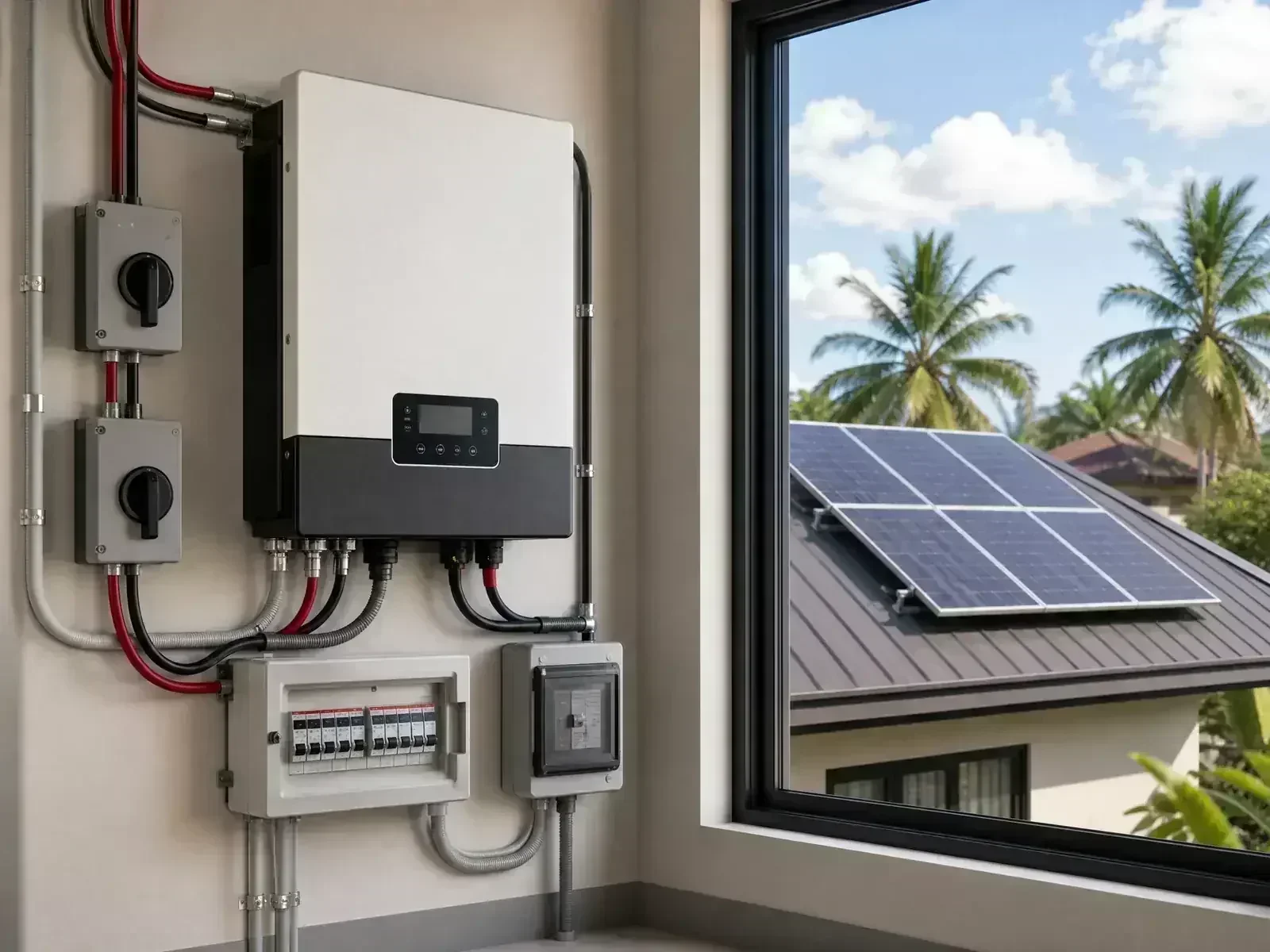
Inverter sizing is based on more than the total panel wattage. Start with the appliances that may operate at the same time, then separate continuous running power from starting or surge power. Refrigerators, pumps, compressors, and some air conditioners can briefly require much more power than their normal rating. A proposal should show the inverter’s continuous output, surge capability, voltage range, and whether the stated rating applies to a single-phase or three-phase installation. For the next planning step, see how much solar power your home actually needs.
Panel-to-inverter ratio
Designers may connect a DC solar array that is larger than the inverter’s AC output to improve production during low-light periods. The acceptable ratio depends on the inverter manufacturer, maximum PV voltage, maximum current, MPPT windows, roof orientation, and clipping assumptions. Never select panel quantity only by dividing inverter kilowatts by panel watts; verify electrical limits from the datasheets.
Choose the Correct Battery Voltage
Small systems may use 12 V or 24 V battery banks, while larger residential systems commonly use 48 V architectures. Higher voltage can reduce current for the same power and may simplify cable sizing, but every battery, inverter, fuse, breaker, and charger must be compatible. Battery voltage is not the same as usable energy; usable capacity also depends on amp-hours, depth of discharge, temperature, battery-management limits, and the manufacturer’s warranty conditions.
Questions to Ask Before Approving a Proposal
Ask for the maximum PV input voltage, maximum MPPT current, recommended panel configuration, surge rating, transfer time, backup circuits, battery compatibility, protection devices, and expected behavior during a grid outage. If the system will support motors or air-conditioning equipment, ask for a starting-current assessment rather than relying on the appliance’s label alone. For the next planning step, see solar roof, shade, tilt, and orientation guide.
Frequently Asked Questions
Can a 5 kW inverter run any 5 kW load?
Not necessarily. The inverter must also support the load’s starting surge, voltage requirements, phase configuration, and the duration of the demand. A motor or compressor may need more capacity than its running wattage suggests.
Should I oversize the inverter for future appliances?
Only if the future plan is realistic and the rest of the system can support it. An oversized inverter can increase cost, while an undersized system may require replacement. Document future loads before choosing a larger model.
Use the Bill for Energy and Appliances for Inverter Sizing
A Philippine bill tells you monthly energy, not simultaneous watts or motor surge. Pair 12 months of kWh history with a daytime appliance schedule and a backup-load list. A refrigerator, water pump, air conditioner, and induction cooker can create different startup and operating requirements even when two homes have similar peso bills. Confirm PV voltage windows, maximum current, continuous and surge ratings, battery voltage, protection, and installation environment against the exact manufacturer datasheet.
Source note: Peso rates and utility requirements change. This is a planning example, not a tariff quote, engineering approval, or promise of savings. Verify the current bill and official utility guidance before purchasing or connecting equipment.