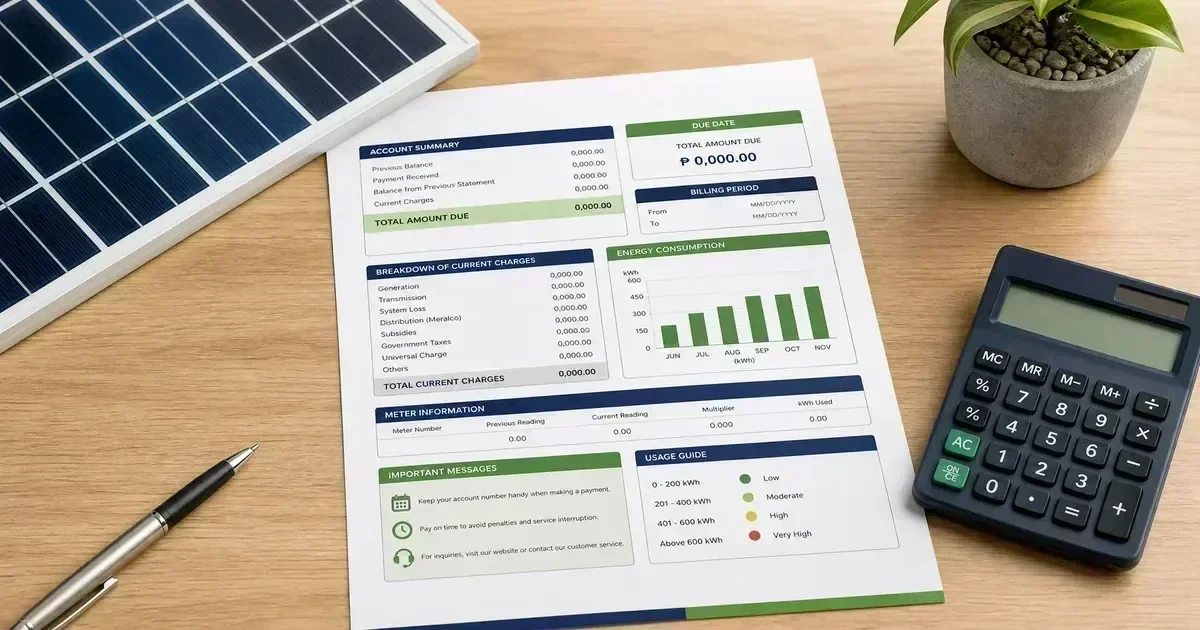
Look for the electricity consumed in kilowatt-hours, usually shown as kWh. This is the number that most closely represents the energy your solar array would need to offset. The bill amount in pesos is still useful for budgeting, but it can move because of fuel charges, taxes, adjustments, and utility rate changes. For the next planning step, see solar roof, shade, tilt, and orientation guide.
How to Read an Electric Bill Before Buying Solar
The most important number for solar sizing is kWh consumed, not the peso total. The peso amount changes with electricity rates and other bill components.
- Record kWh from 3–6 recent bills if available.
- Record the billing days.
- Calculate average daily kWh = monthly kWh ÷ billing days.
- Identify which major loads run during daylight.
- Use the result as a starting point for PV sizing and verify the roof, inverter and load profile.
Do not assume every peso on the bill disappears after solar. Fixed charges, taxes and export treatment can change the actual savings.
Record billing days and meter dates
Two bills with the same kWh may cover different numbers of days. Write down the previous reading date, present reading date, and billing period. Converting the monthly figure into average daily kWh helps compare months and gives a better input for a calculator. For a personalized system check, use the CalcSolarPH solar calculator.
Separate energy from fixed charges
Some bill lines are not reduced one-for-one by producing more solar energy. Distribution, supply, taxes, system-loss charges, and fixed or minimum charges may be calculated differently. Do not assume every peso on the bill represents a kWh that panels can cancel.

Make a six- to twelve-month worksheet
Create a simple table with month, kWh, peso total, billing days, and notes about unusual events. Mark months with visitors, construction, a new air conditioner, extended outages, or long vacations. The average shows the normal baseline, while the high month helps reveal whether your future system needs room for growth.
Estimate average daily energy
Divide monthly kWh by billing days. This is not a solar production forecast; it is a description of household consumption. Solar production depends on weather, roof geometry, equipment, and losses. Use the daily figure to compare a range of system sizes rather than treating it as an exact answer.
Add the missing load pattern
A bill does not tell you when energy was used. Two homes can consume the same kWh but need different designs if one uses most power during sunny hours and the other runs air conditioning at night. List major appliances, their approximate running hours, and whether they are essential during an outage. For the next planning step, see how much solar power your home actually needs.
Use the bill as a starting point, not a quotation
A calculator can convert consumption into an initial panel and inverter range. An installer still needs to inspect the roof, main panel, service capacity, shading, backup expectations, and utility requirements. Bring your worksheet to the site visit; it is more useful than a single bill screenshot. For the next planning step, see our inverter and panel sizing guide.
A simple bill-reading routine
For every new bill, copy the kWh, billing days, and total amount into your worksheet. Recalculate the average after several months. If consumption changes materially, update the solar estimate instead of buying from an old number. This small habit prevents both oversizing and disappointing savings. For the next planning step, see inverter sizing for motors, pumps, and refrigerators.
The 3 Numbers You Need Before Asking for a Solar Quote
- Monthly kWh: this is the energy you are actually consuming from the grid.
- Average monthly bill: useful for budgeting, but not enough to size equipment by itself.
- Daytime vs nighttime usage: this determines how much solar can be consumed directly and how much battery capacity may be useful.
If your bill is ₱10,000 but most of your heavy loads operate after sunset, a battery-backed design can look very different from a home that consumes the same amount during daylight. This is why bill-based solar estimates should be followed by load analysis.
Turn the Bill Into a Solar Planning Number
Record several consecutive bills if possible, not just one unusually high or low month. Then list the appliances that drive the bill: air-conditioners, refrigerators, water pumps, electric heaters, rice cookers, computers and other large loads. Use those numbers in the CalcSolarPH calculator instead of guessing your system size from the peso amount alone.
For example, a homeowner targeting a ₱5,000 monthly bill should not automatically buy a “5kW system.” The correct system depends on the actual kWh represented by that bill, local rate assumptions, daytime consumption, shading and the desired level of backup.
Frequently Asked Questions
Is the peso amount enough to size a solar system?
It is a useful starting point, but monthly kWh is more informative. The peso total changes with rates and adjustments, while consumption in kWh describes how much energy the home used.
What if my bill does not show the same kWh every month?
Use several recent bills and calculate an average, then note the highest month. A single unusually low or high bill can produce an unreliable estimate.
Can solar eliminate the entire bill?
Not necessarily. Fixed charges, imported energy, nighttime usage, utility rules, system losses, and weather mean a solar installation should be evaluated as a reduction or offset, not an automatic zero-bill promise.
For a first estimate, use the CalcSolarPH solar calculator, then compare the result with your actual loads and roof conditions. You can also browse the solar products catalog before speaking with an installer.
A bill is more than one solar-sizing number
Illustrative bill composition only. Actual charges vary by utility, rate class, month, and location; use the kWh line and current tariff details for a real estimate.
| Component | Illustrative share |
|---|---|
| Energy charge | 55% |
| Delivery and system charges | 25% |
| Taxes and government charges | 12% |
| Other adjustments | 8% |
Meralco-Style Bill Reading Example
Record the billing-period kWh first. If a household used 350 kWh and you choose ₱14.80/kWh as a temporary planning assumption, the simple energy reference is 350 × ₱14.80 = ₱5,180. This does not recreate the complete bill because the actual account includes generation, transmission, system loss, distribution, taxes, subsidies, and other charges. Use the peso total as a budget signal, but use kWh and appliance timing for sizing.
| Bill field | Solar-planning use |
|---|---|
| Billing-period kWh | Estimate monthly energy demand |
| Peso total | Check budget and possible savings range |
| Billing dates | Avoid comparing unequal periods |
| Historical kWh | Spot seasonal and behavioral changes |
Source note: Peso rates and utility requirements change. This is a planning example, not a tariff quote, engineering approval, or promise of savings. Verify the current bill and official utility guidance before purchasing or connecting equipment.
350 kWh Monthly Consumption: Meralco-Style Bill and Solar Savings Simulation
This is a transparent planning illustration, not an official current Meralco tariff quote. It uses an editable assumption of ₱14.80/kWh. Meralco explains that a residential bill contains multiple components, and the percentages below are an illustrative breakdown based on its published 2025-average breakdown.
| Planning metric | Illustrative value | How it is calculated |
|---|---|---|
| Monthly consumption | 350 kWh | User scenario |
| Planning bill | ₱5,180 | 350 kWh × ₱14.80/kWh |
| Solar self-consumption | 180 kWh/month | Illustrative daytime solar used directly by appliances |
| Remaining imported energy | 170 kWh/month | 350 − 180 kWh |
| Avoided energy value | ₱2,664/month | 180 kWh × ₱14.80, before fixed charges, rate changes, losses, and export treatment |
Do not interpret the ₱2,664 figure as a guaranteed total bill reduction. Actual savings depend on current rates, the timing of solar production and appliance use, battery losses, system availability, exported energy treatment, taxes, fixed charges, and utility requirements. Verify current information with Meralco’s official bill breakdown.
500 kWh Monthly Consumption: Meralco-Style Bill and Solar Savings Simulation
This is an illustrative planning scenario, not an official current Meralco tariff quote. It uses an editable ₱14.80/kWh assumption and an illustrative 260 kWh/month of solar energy consumed directly by daytime loads.
| Planning metric | Illustrative value | How it is calculated |
|---|---|---|
| Monthly consumption | 500 kWh | User scenario |
| Planning bill | ₱7,400 | 500 × ₱14.80/kWh |
| Solar self-consumption | 260 kWh/month | Illustrative daytime solar used directly |
| Remaining imported energy | 240 kWh/month | 500 − 260 kWh |
| Avoided-energy value | ₱3,848/month | 260 × ₱14.80, before fixed charges, losses, rate changes, and export treatment |
The ₱3,848 figure is not a guaranteed total bill reduction. Actual savings depend on current rates, solar/load timing, battery losses, system availability, exported-energy treatment, taxes, fixed charges, and utility requirements. Verify current information with Meralco’s official bill breakdown.