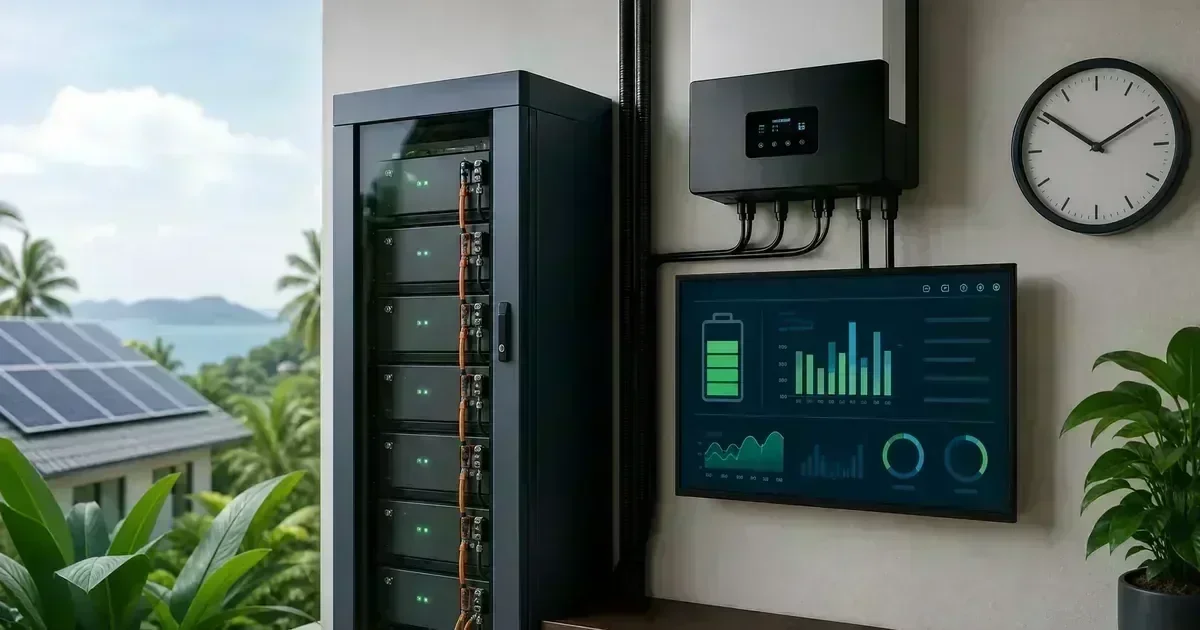
Inverter size answers “can the system run this load right now?” Battery capacity answers “how long can it provide energy?” A refrigerator may need a modest average energy over several hours but still demand a higher starting surge. Both questions belong in the design. For the next planning step, see solar battery-bank safety guide.
Convert battery capacity into usable watt-hours
A battery may be advertised in volts and amp-hours or in kilowatt-hours. Voltage multiplied by amp-hours gives nominal watt-hours. That is not automatically the energy available to the household. Apply the allowed depth of discharge and then account for inverter and wiring losses. For a personalized system check, use the CalcSolarPH solar calculator.
Use an example with assumptions
Suppose a battery has a nominal capacity of 5 kWh, the design allows 80% usable discharge, and the inverter delivers 90% of the remaining energy to the loads. The rough usable output is 5 × 0.80 × 0.90 = 3.6 kWh. At an average 300 W load, that is about 12 hours before other real-world factors are considered.
Build the average-load estimate
List each backed-up appliance, approximate watts, and expected hours. A 60 W fan used for 8 hours contributes about 480 Wh. A refrigerator should be treated as a cycling load, not simply its nameplate wattage for every hour. Add phone charging, router use, lights, and other essential devices.
Include high-starting loads carefully
Motors, pumps, compressors, and some power tools can create a short surge. A battery may have enough total energy but still fail if the inverter cannot handle the instantaneous current. Ask for the inverter surge rating and starting behavior of the actual appliance.
Battery voltage changes the wiring design
12 V, 24 V, and 48 V systems can store similar energy but carry different currents for the same power. Higher-power systems often use higher voltage to reduce current and cable size, but the equipment must be designed as a compatible system. Never mix batteries or chargers solely because their labels look similar.
Plan charging after the outage
Runtime is only half of resilience. Ask how long the solar array needs to recharge the battery, whether the inverter can charge from the grid or generator, and how cloudy days change the plan. A battery that survives one night may still be empty after several overcast days. For the next planning step, see LiFePO4 vs lead-acid battery comparison.
Make the estimate honest
Present runtime as a range based on an average load and a conservative load. Label which appliances are included. Then let an installer verify the battery, inverter, protection, ventilation, and operating limits. A transparent estimate is more useful than a single impressive number.
Frequently Asked Questions
What is the simplest battery-runtime formula?
A practical estimate is usable battery watt-hours multiplied by inverter efficiency, divided by the average load in watts. It should also include the manufacturer’s reserve and operating limits.
Why is the advertised battery size larger than usable energy?
Battery systems normally reserve energy to protect the cells and maintain safe operation. Temperature, age, discharge rate, and inverter losses can further reduce what reaches the appliances.
Does more battery always mean longer backup?
Only if the inverter, wiring, charging source, protection, and load circuits can use the added capacity safely. A larger battery also needs a charging plan and a suitable installation location.
For a first estimate, use the CalcSolarPH solar calculator, then compare the result with your actual loads and roof conditions. You can also browse the solar products catalog before speaking with an installer.
Interactive planning scenario: daily backup energy
Move the slider to see an illustrative daily energy estimate. Real runtime also depends on usable battery capacity, inverter efficiency, reserve settings, temperature, and battery age. For the next planning step, see LiFePO4 battery buying guide.
Worked Battery Runtime Example
If essential loads average 300 W for four hours, the simple energy requirement is 300 × 4 = 1,200 Wh. For a nominal 48 V battery, 1,200 ÷ 48 = 25 Ah before usable-depth limits, inverter efficiency, temperature, aging, reserve, and BMS restrictions. Do not size from nameplate capacity alone. Verify the manufacturer’s usable-energy conditions, continuous current, temperature range, communications requirements, and warranty terms. For the next planning step, see essential-loads backup guide.
Source note: Peso rates and utility requirements change. This is a planning example, not a tariff quote, engineering approval, or promise of savings. Verify the current bill and official utility guidance before purchasing or connecting equipment.
A better way to think about battery runtime
Battery runtime is an energy-budget problem, not simply battery kWh divided by appliance watts. A practical estimate must account for usable depth of discharge, inverter efficiency, battery voltage, the actual load profile, and whether the load stays constant.
Conceptually: usable AC energy ≈ nominal battery energy × allowed depth of discharge × battery/inverter conversion efficiency. Runtime then depends on the average AC load over the period being studied.
- A 1,000W load running continuously is very different from a 1,000W appliance that cycles on and off.
- Starting surges affect inverter capability even when they do not consume much energy over the whole night.
- Higher discharge rates can change the practical usable capacity of some batteries.
For planning, model the actual appliances and schedule rather than assuming the battery will deliver its entire nameplate energy to the AC loads.