The Real Cost Gap Most Homeowners Don't See
Not sure how big a backup system you actually need? Our solar sizing guide walks you through sizing for outages step by step. For the next planning step, see solar-ready home planning guide.
Meralco's residential rate climbed to ₱14.80 per kWh in July 2026, while diesel is hovering around ₱88 to ₱91 per liter as of August 2026. That gap matters more than most people realize once you actually run the numbers on backup power. For a personalized system check, use the CalcSolarPH solar calculator.
Quick Answer
- Occasional short brownouts (a few hours, a few times a month): a generator is usually cheaper upfront and good enough.
- Frequent or multi-day outages (typhoon season, rural areas with unstable grid): a solar-battery system pays for itself faster and won't leave you stranded when fuel stations are also down.
- Both budget and reliability matter to you: many households run a small solar-battery setup for essentials, with a generator as backup.
How Each System Actually Works
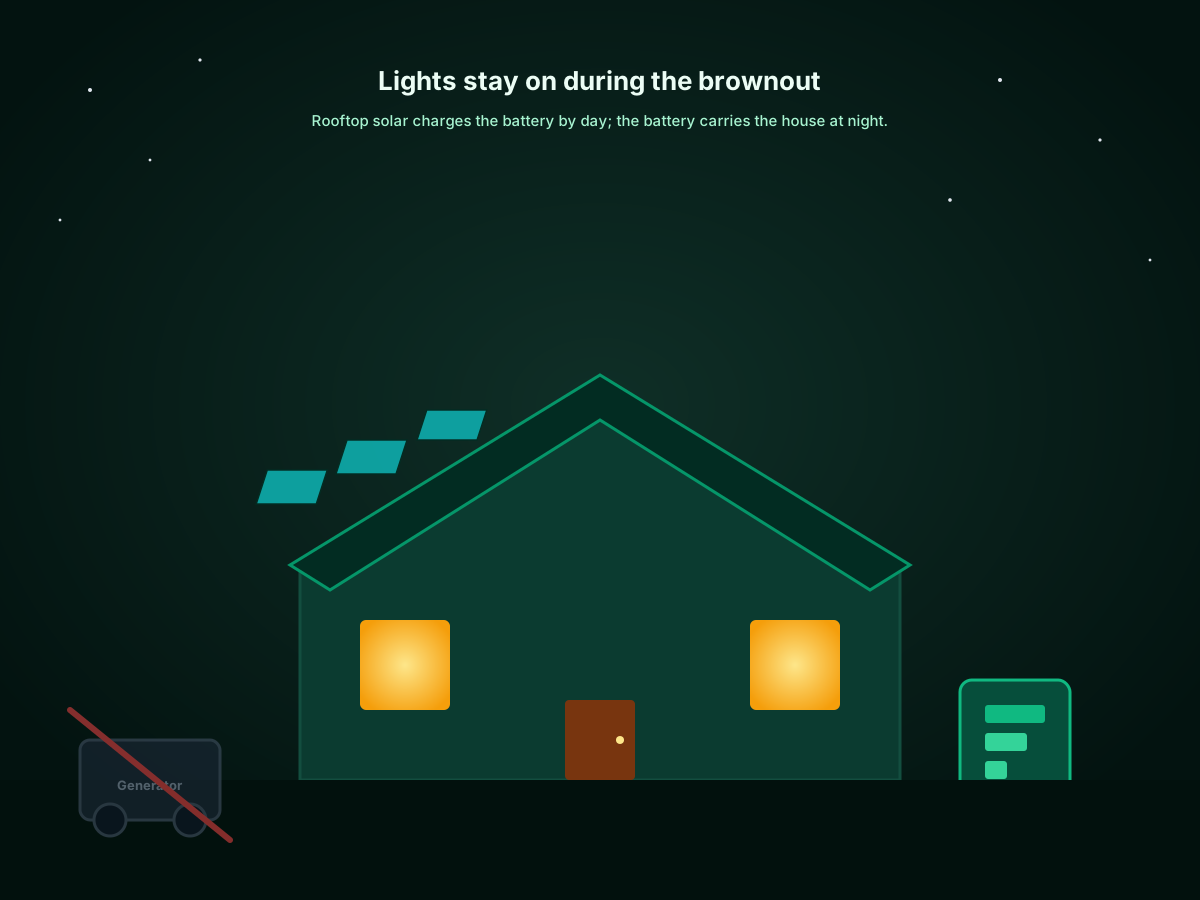
A generator burns fuel on demand. It only produces power while it's running, and stops the moment the tank is empty. A solar-battery system charges throughout the day using rooftop panels, then discharges automatically when the grid drops, often with zero interruption if paired with a hybrid inverter and automatic transfer switch.
The Fuel Math That Changes Everything
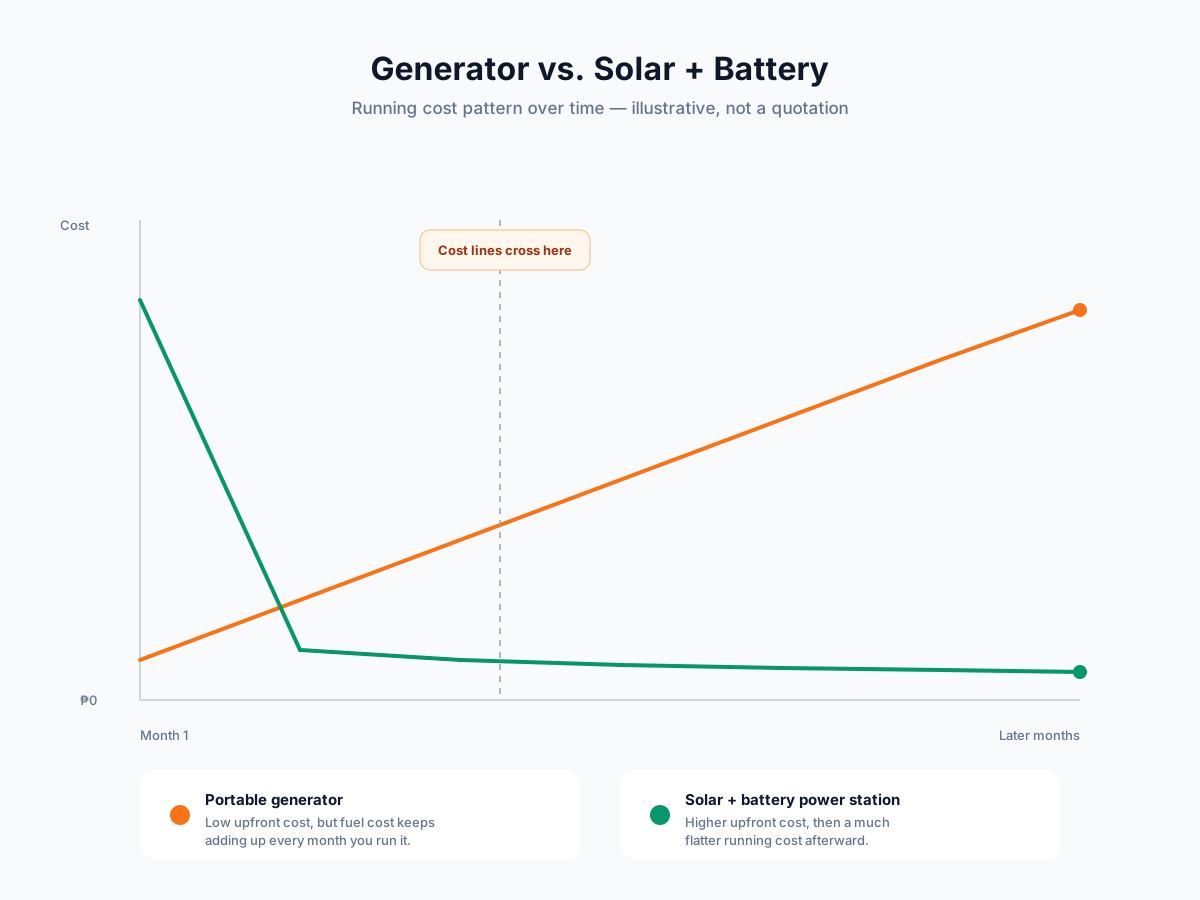
Here's a simple example using current prices. A typical small gasoline generator (around 2kW) burns roughly 1 to 1.5 liters per hour under normal household load. Running it for 4 hours during a brownout costs approximately ₱350 to ₱550 in fuel alone, at today's pump prices.
Do that two or three times a week during a bad typhoon season, and fuel costs alone can quietly outpace what a mid-sized solar-battery system would have cost you to run for the same period, with zero fuel cost once installed.
Upfront Investment
- Gasoline generators are the cheaper entry point, with small units available for a few thousand pesos.
- Solar-battery systems require a much larger initial investment (panels, inverter, and battery banks), but the sunlight itself is free.
- Generators are simple to set up; solar systems typically need professional installation and a roof assessment.
Noise, Fumes, and Upkeep
- Generators are loud enough to disturb neighbors, especially at night.
- Generators produce exhaust fumes and must run in a well-ventilated outdoor space, never indoors.
- Generators need regular oil changes and periodic engine servicing.
- Solar-battery systems are silent, emission-free, and need little more than occasional panel cleaning.
Reliability When It Matters Most
For short, occasional brownouts, either option works fine. The real difference shows up during extended outages: several days after a major typhoon, when fuel stations themselves may be closed or hard to reach. A generator is only as reliable as the fuel you can access. A solar-battery system keeps recharging every day the sun is out, making it the more resilient choice for multi-day scenarios, as long as the battery is sized for your essential loads. For the next planning step, see essential-loads backup guide.
Which One Should You Choose?
If outages are rare and short, a generator covers you at the lowest upfront cost. If brownouts are frequent, you want a silent and low-maintenance setup, or you're already planning to cut your long-term electricity bill, a solar-battery system delivers better value over time. Many Filipino households land on a hybrid approach: a smaller solar-battery setup for essentials, with a generator kept in reserve for worst-case scenarios. See why hybrid systems are the most popular configuration in the PH. For the next planning step, see off-grid vs hybrid vs grid-tied guide.
Frequently Asked Questions
Is solar backup really cheaper than a generator in the Philippines?
On a per-outage basis, no, but over years, yes. A hybrid solar system costs more upfront (typically ₱150,000–₱400,000+) but has near-zero running cost and cuts your daily electric bill too, while a ₱25,000–₱60,000 generator keeps burning diesel at ₱88–₱91 per liter. At ₱14.80/kWh Meralco rates, most systems with meaningful usage pay back within 3–6 years.
How much does a generator cost per hour to run?
A typical 3–5kW generator burns roughly 1.5–2.5 liters per hour. At ₱88–₱91 per liter of diesel, that is ₱130–₱230 per hour, and a multi-day typhoon outage can easily exceed 48 hours of continuous running.
Can solar keep running during long typhoon outages?
A hybrid system with a LiFePO4 battery handles nights and cloudy stretches, and panels still produce partial output on overcast days. For multi-day typhoon outages, a larger battery bank (or pairing a small generator with solar) covers the gap better than either alone. See why LiFePO4 is the right battery for brownouts. For the next planning step, see LiFePO4 vs lead-acid battery comparison.
Compare Backup Cost by Runtime, Not Purchase Price
A fair comparison includes the generator purchase price, fuel, oil, servicing, transport, noise, ventilation, and the cost of starting it during an outage. For solar, include panels, inverter, batteries, protection devices, installation, monitoring, and eventual battery replacement. The cheaper upfront option is not always the cheaper option over years of repeated outages.
Match the backup to critical loads
List the appliances that must run during an outage and estimate their wattage and runtime. A refrigerator, internet modem, lights, fans, and selected outlets may require much less capacity than a whole-home system. Air conditioners, pumps, and compressors can dominate the surge requirement, so they should be assessed separately.
Safety and Practicality in Dense Neighborhoods
Generators require fuel storage, exhaust management, ventilation, and protection from carbon-monoxide exposure. They can also create noise and heat. Solar battery backup is quieter during operation, but it still requires correctly installed protection, clearances, and a qualified commissioning process. Hybrid systems can combine solar, battery, and generator input when long outages or cloudy weather make one source insufficient.
Frequently Asked Questions
Can solar battery backup run indefinitely during a blackout?
No. Runtime depends on battery capacity, sunlight, load, weather, and recharge opportunity. A system designed for essential loads may last much longer than one supporting air conditioning or electric cooking.
Which is better for a short brownout?
For short, frequent interruptions, battery backup may be more convenient because it starts automatically and operates quietly. A generator may be useful for long outages or heavy loads. A hybrid design can provide both options.